
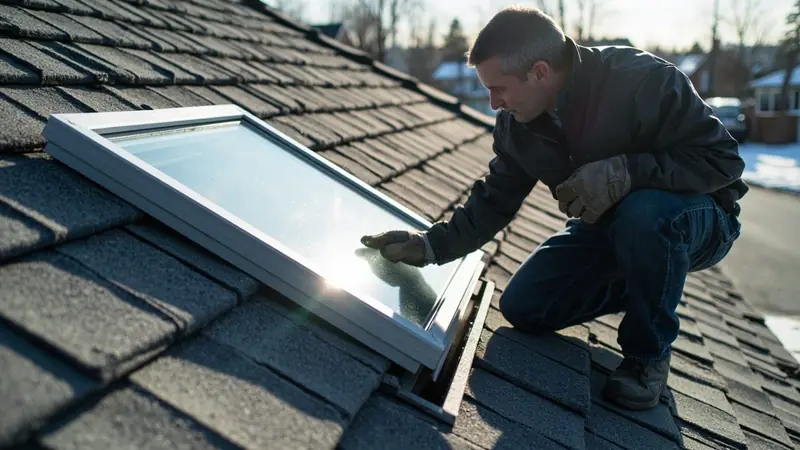
What a skylight leak means
Water at the ceiling under a skylight usually starts at one of three spots: the glass seal, the curb flashing, or the shaft that runs down to the ceiling. Skylight leaks in Ontario homes tend to show up with the first hard rain of the season. That timing is often the first sign something has already opened up above. Flashing is the metal that seals the joint where the skylight frame meets the roof deck. It's usually the first thing checked when water tracks in at one corner instead of the middle.
Keep everyone clear of a ceiling section that is bulging or actively dripping below the skylight. Set a bucket under the drip, and if the ceiling is swelling, open one small hole at the lowest point so the water has a single place to drain. Move furniture and electronics out from under it, then photograph the stain before anything gets wiped up.
Water dripping from skylight glass right after a storm usually points to a failed seal between the panes. A dark ring or a bubble in the drywall along one side of the frame is often skylight leaking around edges rather than a glass failure. It points instead at the curb flashing or a gap in the step flashing beside it.
Fog or beads on the inside of the glass on a cold morning is condensation on a skylight, not an active leak, and it clears once the house warms up. A stain that keeps coming back in the same spot, even when the glass looks dry, usually means skylight leaking when it rains is tracing back to the flashing.
Ontario's wet season packs most of the year's rain into a short stretch. Gusts from a Santa Ana wind event can drive that rain sideways under a curb that holds fine in a straight downpour. A skylight that has never leaked in calm rain can still take on water once wind pushes it against the frame from one side. Homes built from the 1980s through the 1990s commonly carry tile roofs. The underlayment under that tile is often reaching the end of its service life around the same years a skylight's original seal starts to fail, so the two problems can show up in the same storm.
A cracked boot at a nearby roof penetration follows the same pattern as a failed skylight seal. Water runs down into the attic insulation first, the ceiling below stains next, and the framing around the opening starts to soften before any new mark shows on the surface. Call once a stain keeps spreading between rains, or once the drywall around the skylight feels soft when you press it. Waiting past that point means the framing repair grows alongside the roof repair, and a resealing job turns into cutting out wood that is already wet.
Not sure what you are seeing? Our page on roof leaks around chimney explains the signs.
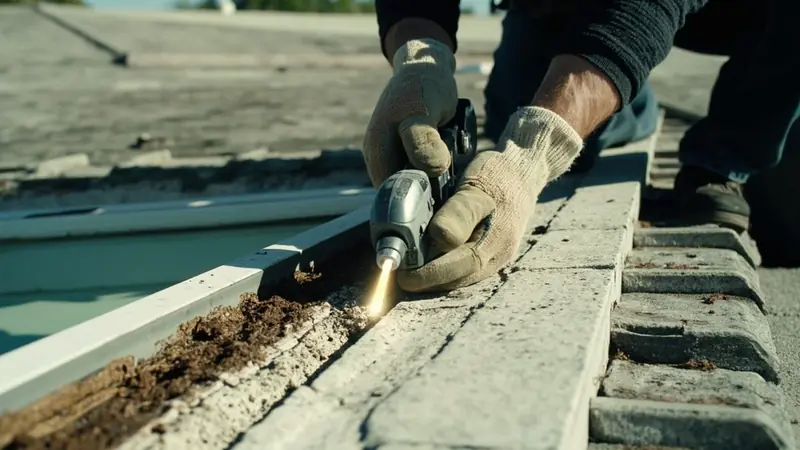

Finding exactly where a skylight leak starts
We trace a skylight leak by starting inside, at the ceiling and the shaft, before anyone climbs onto the roof to look at the glass or the flashing. Where the water shows up inside narrows down which part outside is failing.
- The stain or wet ring on the ceiling gets traced along the framing to the point where water enters.
- The shaft lining and surrounding insulation are checked for dampness that signals condensation rather than an outside leak.
- A moisture meter reading taken from beneath the decking near the curb shows how far the water has spread.
- The curb flashing and nearby step flashing get lifted to look for an open seam or missing piece.
- The glass seal is checked for cracks or fog, since a failed seal can mimic a flashing leak's stain.
- Each finding gets documented, and we bring one repair that matches it, with a quote you can approve.
Near the curb, a decking reading below 15 percent points to a recent, surface-level fault. A seal swap or a flashing repair can usually go in without opening the deck further. A reading past 20 percent means that section of decking has already been soaking, and it has to come out before new flashing or a new unit goes back in. That reading, not how old the skylight looks from the ground, is what decides whether this stays a repair or turns into cutting out wet wood.
Which fix fits depends on where the water is getting in. A cracked or fogged unit calls for skylight seal replacement, since the fault lives in the glass. A torn or undersized curb or step flashing calls for skylight flashing repair, re-forming or replacing the metal instead of caulking over the gap. If the trouble is condensation building at the shaft rather than a leak from outside, the fix is airflow at that opening, not a repair to the glass or the metal. When the unit itself has failed past a simple reseal, that moves into skylight installation and repair rather than a patch.
The CSLB License Lookup publishes the rules that govern work like this in your area.
Steps for fixing a skylight leak
Finding where it leaks
The visit starts at the ceiling stain, then moves to the shaft and the roof around the skylight. We trace the stain, check the shaft insulation, read the decking with a pin moisture meter, and inspect the curb flashing and the glass seal, all in one visit. You walk the attic or shaft with us when it's accessible, and you see the moisture reading and the flashing condition before we name a cause. The visit ends once the source is named and you have a written quote in hand for the fix that matches it.
Approving the repair
After you approve the quote, we protect the ceiling below and clear tile or shingles away from the curb first. If the glass seal has failed, the unit gets resealed or the insulated glass panel gets swapped. If the flashing is torn or undersized, the curb and step flashing get re-formed or replaced rather than caulked over. If wet insulation is driving condensation at the shaft, that insulation comes out before anything closes back up. Nothing opens further than what the quote covers.
Checking the fix
A pin moisture meter goes back on the decking near the curb once the repair is in. It has to read dry, under 15 percent, before the job is finished. We show you that reading alongside the spot where the old leak was traced. If flashing was replaced, you see the new piece set before the tile or shingles go back over it. That reading is the proof that the fix matches the source we found, not just the stain on the ceiling.
What it takes to fix a skylight leak in Ontario
Replacing curb flashing or reworking the shaft around a skylight usually counts as repair work under the California Residential Code. That kind of work usually needs a permit from the City of Ontario Building Department before it starts. A like for like reseal of the glass unit, without touching the flashing or the deck, often doesn't need one, and the department reviews each case on its own.
A common shortcut on tile roofs from the 1980s and 1990s is resealing the glass without lifting the surrounding tile. That leaves a damaged step flashing underneath, free to keep leaking once the new seal is in. Another shortcut is caulking over a gap instead of re-forming the curb flashing. That holds only until the next Santa Ana gust drives rain in sideways. The stain returns in the same spot. Either shortcut treats the surface instead of the source the moisture reading points to.
Our crews work to the installation standards of the National Roofing Contractors Association.
What to expect once you call
What the call decides first
On the phone we ask whether water is actively coming through right now or just showing as a stain, and whether anyone can see daylight through the skylight frame. Active water coming through during a storm typically brings someone out right away. A stain that has already dried between rains can wait for a scheduled visit without the damage getting worse in the meantime. Either way, we ask when the stain first appeared and whether it tracks with wind or rain.
What the visit disturbs
Checking a skylight leak means time on the roof around the unit and time in the attic or shaft below it. Clear furniture and anything that can't get wet out from under the skylight before the visit. Insulation around the shaft gets moved aside to see the decking and the back side of the flashing, and that insulation goes back once the check is done. The ceiling itself is only opened if the stain has to be traced further.
What sizes the fix
A reseal at the glass is a repair at one point and usually stays small. Damaged curb or step flashing often means opening the roofing around the skylight, not just the unit, which is a bigger job than a reseal. A shaft lined with wet or compressed insulation adds another opening, inside the house this time. No work begins on the roof or ceiling until you've reviewed and approved the written quote.
What you see during the visit
We show you the stain traced back to its source, whether that's the glass seal, the curb flashing, or the shaft, pointing to it on the roof or from inside the attic. You see the moisture reading before anything is decided. If flashing has to come out, you see the old piece once it's off. Nothing opens further on the roof or the ceiling until you say go ahead.
Skylight Leaks Questions From Ontario Homeowners
Stopping a skylight leak means fixing the part that failed: the glass seal, the curb flashing, or the shaft. If moisture is condensation at the shaft, the fix is airflow. A pin moisture meter reads the decking near the curb, and a reading under 15 percent confirms the area is dry before closing the roof back up.
What decides how long a skylight lasts is its glass seal and curb flashing. The seal fails when it dries and cracks, letting water track in with the first hard rain. Flashing fails when wind out of the Santa Ana pattern pushes rain sideways under the curb edge. Homes with tile roofs from the 1980s and 1990s often reach the end of the underlayment's service life around the same years the seal gives out, so both problems can surface in the same storm. A pin moisture meter on the decking shows whether water has already soaked past the surface.
Set a bucket under the drip and keep clear of any ceiling section that is bulging or dripping. Check the inside of the glass for fog, since condensation on a cold morning clears once the house warms up and isn't an active leak.
Skylight leaks happen often enough that they rank among the usual roof complaints in Ontario homes. Rain exploits whatever seam has opened since the last storm, whether that is a dried-out glass seal or flashing that no longer sits tight against the curb. Santa Ana gusts push rain sideways under edges that hold fine in a straight downpour, which catches skylights that never leaked before. Fog on cold glass is not part of this pattern since it clears as the house warms. A stain that keeps reappearing between storms means one of the usual failure points has opened.
What determines a skylight's service life is how well the curb flashing laps under the roofing above it. Flashing lapped correctly under tile courses sheds wind-driven rain for years. Flashing that only sits on top fails the first time wind pushes rain sideways. The glass seal fails independently when it dries and cracks, so a newer flashing job can still show a leak at the glass. Homes with concrete tile from the 2000s on need that lapped detail, while older tile stock from the 1980s and 1990s often needs both the seal and underlayment checked at once.
Not every skylight leaks, but the glass seal and the curb flashing both age and eventually need attention. A seal dries and cracks with sun and temperature swings, letting water track in once it fails. Flashing holds up fine in a straight downpour but can open once wind out of the Santa Ana pattern drives rain sideways under the curb edge. Tile roofs from the 1980s and 1990s often show both problems close together, since the underlayment beneath the tile ages on a similar timeline.
Why Ontario's wet season changes a skylight leak fix
Ontario sits in San Bernardino County, where most of the year's rain falls in a short, hard window, and wind out of the Santa Ana pattern can drive that rain sideways rather than straight down. A skylight curb that sheds a normal downpour can still take on water once wind pushes it under the edge. Flashing here has to seal against that sideways push. Homes built from the 2000s on commonly carry concrete tile roofs, so a skylight set into that tile needs flashing lapped correctly under the tile courses above it. Homes built in the 1980s and 1990s often have tile over aging underlayment. A skylight leak on these roofs can appear along with underlayment that needs repair.
Work that opens the roof deck around a skylight gets inspected before new roofing goes back over it, since the condition of the decking can't be checked once tile or shingles cover it again. The review looks at how the flashing laps under the tile courses and whether the deck itself is sound, not just the finished seal visible from the yard. That is why cutting back to dry wood before closing the roof matters more than the surface work most homeowners notice, and why a repair that only touches the visible bead of caulk can look fine and still fail in the next storm.
Roofing Services Near Ontario
If you are seeing skylight leaks anywhere in the Ontario area, call (909) 330-4661 and we can tell you what to check first.
Address:
Ontario Roofing, 4335 E Lowell St, Suite G
More Common Roofing Problems in Ontario
After a storm, you can look at the shaft and the attic around the skylight with a flashlight for staining, daylight, or damp insulation. That check stops once you'd need to get on the roof itself. Lifting flashing, resealing the glass, or stepping onto a wet or tile roof belongs to the visit, since a slip there is how people get hurt.
Know when the stain first showed up and whether it tracks with rain, wind direction, or just cold mornings. Check whether the skylight has double-pane glass and roughly how old the roof is, if you know it. Find a spot where you can view the shaft or attic near the skylight with a flashlight before you call.