
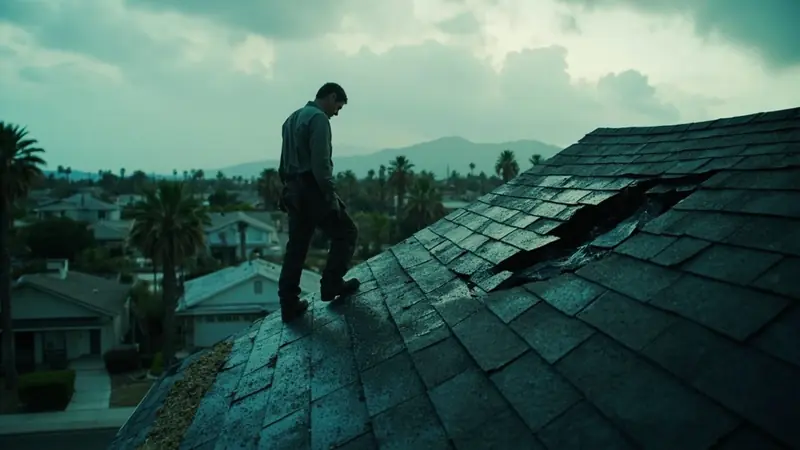
How strong does wind have to be to damage a roof?
Wind doesn't need a named storm to open a roof. Once a shingle edge lifts, the next gust works underneath it, and storm damage roof repair in Ontario usually starts right there, at one lifted tab. Do this first, in this order:
- Move everyone away from sagging ceilings and close the room.
- Shut off the circuit at the panel if water is near any light or smoke detector.
- Stay off the roof and call from the ground.
A missing shingle in the yard, a dark ring on the ceiling, or granules piling up at the downspout outlet all point the same direction. Hail dents on roof surfaces often sit beside a bruised spot nobody notices without lifting a tab. A roof leaking after storm rain tends to show up a day or two after the wind dies down. A wind damage roof problem that also took down a fence section or stripped siding needs more than a shingle check, so mention that on the call too.
Figuring out how far the wind traveled across the slope, not just where a shingle fell into the yard, is where storm damage roof repair starts. A tab that held through one storm can still be weak enough to go in the next one. A single missing shingle today is a signal.
Ontario's fall and winter Santa Ana gusts find any tab that's already loose. The rain that follows in that same stretch drives water through whatever those gusts opened. A raised shingle tab allows wind to slip beneath the next course up. The next storm can peel that whole strip, and the bare deck underneath takes the rain directly. That's the point to call, while it's still one tab and not a stripped section. A fallen tree roof damage situation, where a limb punched through the decking instead of just lifting shingles, is also a same day call.
After severe weather, FEMA's guidance on documentation makes the difference in how smoothly a claim goes.


What happens when we come out after a storm
We work the slope in the order wind hits it, starting where you saw damage first. The visit starts at the lifted tab or torn edge, checks the valleys next, then every vent and pipe boot nearby, and finishes across the open field. That order keeps a bruised section near the ridge from getting missed just because it wasn't visible from the yard.
On every tab we check, we lift the corner to see whether it still flexes or whether it cracks and sheds granules in your hand. A tab that flexes gets resealed or replaced one course at a time. A tab that cracks and loses its granules means that section has aged out, and the repair becomes hail damaged shingle replacement across the whole run instead of a single spot.
A limb that punched through the decking instead of just lifting shingles is fallen limb roof repair, and that gets a tarp over the hole before anything else starts. Storm damage roof tarping on an open hole comes first because roof holes after storm winds let rain straight into the attic insulation below, and that soaks faster than any patch can dry out.
If the repair grows past a patch, material comes up next. An impact rated shingle is graded by a steel ball impact test where Class 4 is the top step. It carries a thicker mat or a modified asphalt that stays flexible in cold weather and weighs more per square, worth asking about wherever hail rides in on the same storms as the wind. Storm damaged roof repair on a hail prone slope is often where that question gets asked.
Hail damage roof repair decisions follow the same granule check on every slope, whether the damage is one tab or the whole field. You see the reading on the spot the tab came from, and the quote reflects what that reading found. That reading also decides whether flashing or a boot gets reset at the same time, since a gust strong enough to lift shingles usually moved more than one piece of metal on the roof.
Not quite your problem? Read about emergency roof repair instead.
Before any part gets replaced, ask to see each of these readings.
| Instrument | Good reading | Bad reading | What it changes |
|---|---|---|---|
| Shingle flexibility and granule check | A tab lifts slightly at the corner and the granules stay put | The tab cracks when it is lifted and granules come off in your hand | The asphalt has aged out |
| Ponding check on a low slope roof | The surface is dry and the drains are clear within about two days of rain | Standing water still sitting two days after rain | Loads the deck and works at every seam |
| Core cut sample on a low slope roof | The insulation core comes out dry through every layer and the deck under it is sound | A saturated or crushed core | The wet area is larger than the visible stain |
How the storm repair visit runs
Finding where it let go
We walk the slope from where you saw damage first, checking tabs for flex and the mat for cracked granule loss, then move to valleys, vents, and pipe boots before covering the open field. In the attic we look for staining and daylight at penetrations, since water travels along the underside of the decking before it drops. That combination, roof surface and attic together, shows whether this is one section or a wider problem. You get a plain answer on the spot, and the written quote follows before anything else happens.
The repair and your approval
Once you approve the quote, we tarp any open hole first so the house stops taking water while the rest of the work gets set up. Loose or torn shingles come off down to sound material, not just the visible gap, since wind usually took more than what's lying in the yard. New shingles go in matching the surrounding course, and any flashing or boot that moved in the storm gets reset or replaced at the same time. Nothing past the tarp happens without your go ahead on what the quote covers.
Checking the repair holds
Before we leave, a pin moisture meter against any decking that got exposed should read under 15 percent. A reading at or near that line tells you the deck underneath is dry, not just covered over. Before the new section is sealed, you can review that reading along with the pulled shingles to see the storm's impact.
What storm damage repair needs to include here
A full section replacement after storm damage typically needs a permit, and that work falls under the California Residential Code. The City of Ontario Building Department signs off before the job closes out. A single shingle swap or a small patch usually doesn't rise to that level, but the building department decides where that line sits on a given roof.
Houses built in the 1945 to 1970s wave already carry roofs that are worn going into a storm. A strip that peels on one of these takes more of the field with it than the same wind would take on a newer roof. Skipping the attic check and patching only what's visible leaves a soaked section of decking in place, and the next rain finds it again.
On 1980s and 1990s tile roofs, underlayment reaching the end of its life is often the real failure. Tarping over cracked tile without lifting a few pieces to check the paper underneath misses that, and the house keeps taking water through a roof that looks fine from the street.
Walking the full roof to catalog every bruised tab and cracked tile after a storm is after-storm roof inspections work. That's the visit that catches damage the homeowner never saw from the ground.
We explain insurance claim guide for roof damage in more detail in our resources.
What the storm visit looks like for you
Today or a scheduled visit
We ask if water is dripping inside right now and whether anyone is under the damaged area. An active drip inside usually means someone is on the way today. A lifted tab with no water coming through yet can often wait for a scheduled visit instead. We also ask when you first noticed it and whether it followed a specific storm, since that helps us picture the slope before we're on it.
What the visit disturbs
Expect attic access opened to trace a stain back to the tab or boot that let water in, and a tarp set over any hole while the plan gets written. Clear anything stored near the attic hatch before we arrive. Furniture or electronics under a known leak are worth moving yourself if you can reach them safely. Outside, nothing gets moved beyond the roof and the ladder's footing.
What decides the repair size
Permit and disposal requirements set by the local jurisdiction decide more of this job than the storm damage itself. A single section pulled and hauled stays small. A full tear off that triggers a permit review and more disposal volume moves the job further. Whether flashing and boots get replaced along with the shingles adds to that too. You see the written quote before anything further gets opened, and you approve it before work starts.
What you see before we start
We show you the bruised or cracked shingle where it sits on the roof, or a photo of it from the attic side. You see the options for that section before we move to the next one. Any damaged decking comes out where you can look at it. Nothing past the first find gets opened further without you saying go ahead.
Storm Damage Roof Repair Questions From Ontario Homeowners
Move everyone out from under a sagging ceiling and close that room off. Stay off the roof and call from the ground instead of climbing up to check it yourself. Note when the leak started and whether it followed a specific gust, since that detail helps picture the slope before a visit.
Shut off power at the panel when water sits near a light or smoke detector. Keep people away from the wet ceiling and close off that room. Stay off a wet, storm damaged slope and call instead of climbing up to look. Have the room, the timing, and whether the drip has stopped ready when you call, since that decides how soon someone comes out.
A bent ridge cap means wind pried up the cap shingles at the ridge vent opening. Once that cap lifts, the seal over the vent breaks, and wind driven rain can reach the attic through it. The ridge vent's exhaust net free area is supposed to be matched by intake at the soffit. A bent cap changes how that opening performs even if the deck underneath looks fine. Check the cap for cracks or granule loss the same way other tabs get checked, since a bent cap flexes differently than one that cracked outright.
A cracked pipe boot usually moved in the same gust that lifted the shingles nearby. Wind strong enough to pull a tab loose typically works at the rubber collar around a vent pipe too, since both sit exposed on the same slope. A cracked boot lets water track down the pipe into the attic even when every shingle nearby looks intact. Boots and flashing get checked alongside the tabs during a storm visit rather than as a separate issue. A split or pulled collar gets reset or replaced at the same time as the shingles.
Santa Ana gusts loosen shingle tabs mechanically, while rain afterward finds whatever opening those gusts created. The wind itself doesn't need rain to do damage, it works a lifted edge loose each time a gust catches it from underneath. Once a tab's seal breaks, the opening sits there dry until rain arrives in the same stretch of weather and drives water through it. That gap between the wind event and the first leak is why a roof can look fine right after a windy day and still be compromised.
A lifted tab on one slope doesn't automatically spread to the rest of the roof. Wind usually works one section at a time, following the path it traveled across that slope, so damage often stays where the gust hit hardest. A visit still checks valleys, vents, and pipe boots near that tab before moving across the rest of the field, since the same gust that lifted one tab may have moved other pieces of metal nearby without pulling anything off. A single lifted tab is a signal to check that slope closely.
Why heavy winter rain changes storm damage roof repair here
Ontario's rain mostly falls in a short winter stretch, and when it comes, it often arrives in a few heavy hours rather than steady days. A valley that handled last year's storms fine can still back up when a bigger cell dumps rain faster than the slope can shed it. Gutters that collected leaves through fall add to that, since water that can't clear the downspout backs up behind the drip edge instead. On a low slope section, the same rain sits in a scupper until debris clears, and that's where ponding starts. None of this needs a named storm, just enough rain in a short enough window to outrun whatever's blocking the path off the roof. That's why repair after a heavy rain event often starts at the gutter and the valley.
Replacing flashing or a boot along with the shingles can shift a repair into a bigger review than swapping shingles alone, since the covering and the metal underneath aren't inspected the same way. A storm that tears both off at once usually means both get looked at together rather than patched in two separate passes. That's part of why a full written quote comes before the tarp comes off, not after, so the job matches what failed.
Storm Damage Roof Repair Across Ontario and Nearby Towns
We handle storm damage roof repair across Ontario and in these nearby towns.
Roofing Services Near Ontario
Looking for storm damage roof repair near you in Ontario? Call (909) 330-4661 and we will confirm we cover your street.
Address:
Ontario Roofing, 4335 E Lowell St, Suite G
More Emergency Roofing Services in Ontario
Clearing debris from a gutter you can reach without climbing onto the roof is something you can do yourself. Stop there. Checking whether a valley or a tarp is holding after a storm means walking a wet, storm damaged slope, and that's a fall risk no homeowner should take on. Tracing a leak back to its source and resetting flashing belongs to the visit.
Know when the leak or missing shingles showed up, and whether it lined up with a storm or a specific gust. Note which room or ceiling area is affected, and whether the drip has stopped or is still running. If you can see the roof from a window, note roughly where the damage sits. Have the roof's age ready if you know it.