
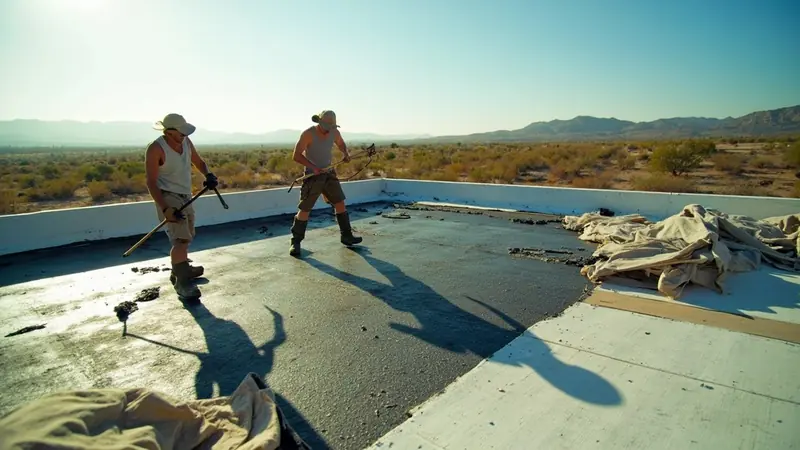
Commercial roof replacement for occupied buildings
Patches stop holding once a flat or low-slope roof reaches the end of its service life, and at that point a commercial roof replacement is the only way to stop water finding new paths in. A replacement takes the surface down to the deck across the whole section, not just at the leak point. Staff or tenants usually see the problem first: a brown ring spreads across a ceiling tile, or a leak only shows up when wind drives rain from one direction, pointing straight at a wall or parapet. Each repair seems to hold for a while, then the same spot opens again a few feet away.
Age shows up on its own terms too. Shingle tabs on a sloped section crack when you lift a corner, granules come off in your hand, and fasteners stop holding, so a roof past its lifespan opens a new leak every time the last one gets patched. On the flat membrane, a tiny pinhole at a seam lets water track sideways between the membrane and the insulation below it. A board under that path loses its insulating value, and the decking corrodes well past the hole visible from the surface. That is why a roof beyond repair can still look sound from a ladder.
Commercial roofing contractors handle this work on a different schedule than a house call, because the building usually stays open and occupied while the roof comes off in sections. Long summer heat cycles work at every seam on a low-slope roof here, and the dry wind gusts that move through the metro in fall and winter find any edge the heat already loosened. A roof that already carries an older membrane built up underneath holds heat longer and gives the wind less to grip, which changes how fast a small leak turns into standing water inside.
Watch for the pattern that means it is time to call instead of patching again. A ceiling stain that returns within weeks of the last repair is one sign. A soft or spongy feel pressing against the underside of the deck is another. More than one leak opening in the same storm is a third. Once a second wet spot shows up, sealing a seam somewhere else will not stop water already moving under the membrane, and that combination is the point to call.

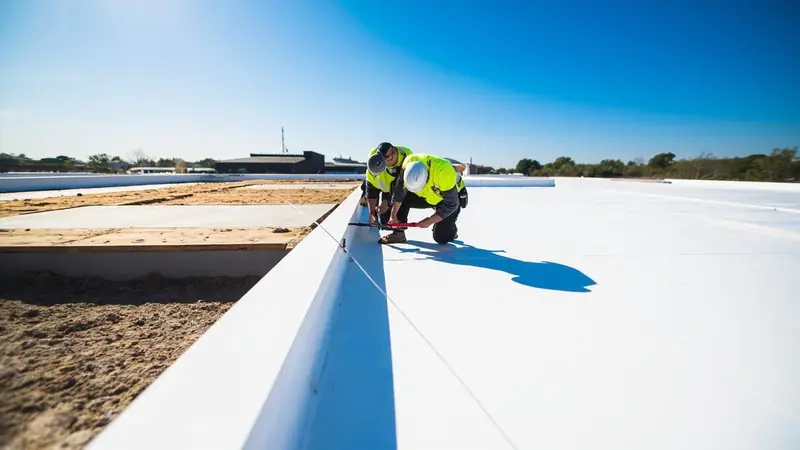
Tear off, deck check and new membrane installation
A commercial roof replacement moves from an opened test cut to a finished, welded membrane in a set order. We cut a small core sample from the low-slope section to check how dry the insulation and deck are under the surface. We count how many layers of old roofing are already in place and note where the roof tear-off has to start.
We strip the section down to solid decking and check for soft or delaminated boards that need a roof deck replacement before anything new goes down. We flash penetrations, parapets and drains before the new membrane goes on. We weld the TPO seams and probe each one for a solid bond. We walk the finished roof with you and point out where the drains and flashing were redone.
The core sample is the finding that decides how far this job goes. A dry core through every layer, with a sound deck underneath, means we replace commercial roof covering without opening the deck itself. A saturated or crushed core means the wet area reaches further than the ceiling stain shows, and patching the top layer will not dry out what is underneath, so the flat roof replacement expands to the whole section.
Low-slope roof replacement work on a building like this usually goes down in TPO, mechanically attached or fully adhered, and the numbers for each one are worth weighing side by side. Dry summer heat and the wind gusts that move through the metro from fall into winter push many buildings toward a fully adhered membrane, since it carries fewer seams exposed to wind uplift than a mechanically fastened sheet. A few buildings here call for PVC roofing instead of TPO, usually where kitchen grease or chemical exposure on the surface would break down a TPO sheet faster.
The CSLB License Lookup publishes the rules that govern work like this in your area.
Pick the two options that fit your building, then ask which one makes sense for it.
| Option | The numbers a buyer weighs | Best suited to |
|---|---|---|
| Architectural laminated shingle | Two laminated layers that are glued together so it is heavier and thicker than three tab | Most steep slope roofs on a building |
| Impact rated shingle | Graded by a steel ball impact test where Class 4 is the top step | Hail country and exposed roofs |
| Three tab shingle | One layer with cutouts, lighter per square | Low exposure roofs where first cost decides |
The replacement from start to finish
Assessing the roof on site
We start on the roof itself. In one pass, we count the existing layers, walk the deck checking for a soft or spongy feel, and cut a small core sample on the low-slope section to see how deep the moisture goes. You get to see the core as it comes out, dry or wet, and we point out where the ceiling stain lines up with what is happening on the deck above it. Once the layer count and the core reading are in hand, we write up what the covering needs and hand you a quote before anything gets opened further.
Approval and tear-off
You approve the quote, then the section comes off down to solid decking, with old flashing and boots pulled along with it. Any board that turns up soft or delaminated gets swapped for new decking before the new system goes down. New flashing goes in at every penetration, wall and drain first, then the membrane follows, welded seam by seam across the section.
Final check and walkthrough
Once the membrane is welded, we check back after sunset with an infrared scan across the new surface. A field that cools evenly across the scan means no wet insulation got sealed in under the new membrane. Any warm patch showing up means a section needs to be reopened and checked with a core before we call it finished. We show you the scan readout and walk the drains and flashing points with you one more time before leaving.
Permitting and sequencing for an occupied building
A commercial roof replacement usually calls for a permit here. The City of Ontario Building Department looks at the job before work starts, including how many old layers of roofing can stay under a new one. That review is also where the owner finds out whether this job qualifies as a recover or has to come off down to the deck.
Skipping the layer count is the shortcut that causes the most trouble on this job. A crew that recovers over an existing membrane without checking what sits underneath can seal in insulation that was already wet and failing, which shortens the life of the new surface before it has even been on the roof a full season. Commercial reroofing on a building that already carries more layers than the permit review allows has to come off first, since adding another layer on top is not an option the review will approve.
Industrial roofing services run into a related issue when rooftop equipment such as vent stacks sits on a deck that was never checked for the extra point load such equipment adds. Multi-family and apartment roofing jobs carry a different pressure, since occupied units sit directly below the work, so the tear-off gets sequenced and covered section by section as it goes.
Heat and wind both affect sequencing here. Crews plan welded seams for the cooler part of the day, since hot, softened membrane underfoot during peak summer heat makes for a seam that will not bond evenly. Any section left open overnight gets covered against the dry wind gusts that move through the metro in fall and winter, since those gusts get under an unsecured edge fast.
If the building also needs flat roof repair, that page covers what the work involves.
Our crews work to the installation standards of the National Roofing Contractors Association.
Scheduling, access and sign-off on this job
Active leak or planned project
On the call we ask where the water shows up inside and whether it is actively dripping right now. An active drip usually moves this to the top of the list, while a dry roof that is just past its lifespan gets set up as a scheduled visit for the core sample and layer count. Either way, that first conversation decides which one this is before a crew gets sent out.
What gets opened and cleared
A commercial roof replacement disturbs the space right under the section being torn off, since dust and debris can filter down through any gap until the new deck is sealed. Clear stored items and equipment from directly beneath the work area before the crew arrives. Rooftop units, vent stacks and satellite equipment on the section being replaced come down and get reset once the new membrane is in, so anything mounted up there gets flagged beforehand.
What decides job size
How many layers of old roofing are already up there decides most of what this job takes, since each extra layer means more tear-off and more material hauled away before new roofing goes down. A roof with one layer and a sound deck underneath stays a smaller job than one with two or three layers stacked over soft decking. You see the layer count and the deck condition written into the quote, and you approve it before the tear-off starts.
Shown before work starts
You see the layer count, the test cut and any soft decking found once the old roofing comes off, before any of it gets covered by new material. We walk through the membrane options that fit the building and the local conditions, and you pick before the welding starts. Any decking that gets pulled out gets set aside so you can look at it, not just hear about it.
Commercial Roof Replacement Questions From Ontario Businesses
Replacement timing depends on membrane condition. Repeated ceiling stains that return within weeks, a soft feel under the deck, and more than one leak opening in the same storm are the signs that mean it is time to call instead of patching again.
Tax treatment of a roof replacement is a question for a tax professional. What we can tell you is what decides the size of the job: the layer count found during tear-off, whether the deck needs board replacement, and which membrane fits the building.
A 25 percent slope means the roof rises 3 inches for every 12 inches of horizontal run, which equals a 3:12 pitch. That is still a low-slope roof by commercial standards, so it drains more slowly than a steep residential roof and depends on membrane seams and drains working correctly rather than gravity alone. On a roof at this slope, ponding and seam performance matter more, which is why a core sample and layer count get checked before any covering decision is made.
A reflective white membrane lowers roof surface temperature by reflecting sun instead of absorbing it. This cuts how much heat moves through the deck into the space below. On a building with long summer heat cycles, a cooler membrane surface means less expansion and contraction stress at every welded seam over time. TPO, the membrane most often used on low-slope sections here, is installed in this light color for that reason, alongside PVC where grease or chemical exposure rules out TPO.
Clearing the roof falls to the building owner or manager before the crew arrives, specifically the space directly beneath the section being torn off. Dust and debris can filter down through gaps until the new deck is sealed, so stored items and equipment need to move out of that area first.
Wind damage after installation shows up at the membrane first, specifically at seams and edges where uplift can catch and lift the sheet. The deck only gets affected if a lifted or torn membrane lets water track underneath, which is the kind of damage a core sample or infrared scan would catch on a later visit.
Standing water near a scupper means the drain path is blocked or the surface has lost its slope toward it. It works at the seams around that low point every time it sits there. The ponding check calls this out directly: water still sitting about two days after rain loads the deck and works at nearby seams, while a dry surface with clear drains within that window is the expected condition. Marking the water line with chalk shows on a later visit whether the area is draining or still growing.
Why heat and wind change commercial roof replacement here
Long, dry summer heat pushes roof surface temperatures well past the mid-90s air highs the valley sees in August, and that cycling works at every seam on a low-slope membrane faster than it would in a milder climate. When the season turns, dry wind gusts move through the metro and find any seam or flashing edge the heat already loosened. Rain here concentrates into a short winter stretch, so that is when every drain and seam gets tested at once rather than gradually across the year. Flat and low-slope commercial roofing, covered in TPO, EPDM, built-up or modified bitumen material, makes up a good share of the local commercial building stock. That is why seam welding and attachment method matter here as much as the covering itself.
That same review looks hardest at drains, parapets and any rooftop equipment anchoring, since those are the points most likely to leak or lift in a wind event. On an occupied building, inspection often happens in stages as each section comes off and goes back down, rather than one pass at the very end. That staged approach is why the layer count and deck condition get written into the quote as they are found.
Commercial Roof Replacement Across Ontario and Nearby Towns
Commercial roof replacement calls reach us from all over the Ontario area, including these towns.
Roofing Services Near Ontario
Need commercial roof replacement in Ontario? We cover the city and the nearby towns on the map. Call (909) 330-4661 to check your address.
Address:
Ontario Roofing, 4335 E Lowell St, Suite G
More Commercial Roofing Services in Ontario
- Commercial Roof Repair
- Flat Roof Repair
- Commercial Roofing Contractors
- TPO Roofing Systems
- EPDM Flat Roofing
- PVC Roofing Installation
- Modified Bitumen Roofing
- Built-Up Roofing Systems
- Roof Coatings & Restoration
- Commercial Metal Roofing
- Commercial Roof Maintenance Plans
- Commercial Roof Inspections
- Industrial Roofing Services
- Multi-Family & Apartment Roofing
- All commercial roofing services
- Wind Damage Roof Repair
- Storm Damage Roof Repair
- Emergency Roof Repair
After a windstorm, clearing debris from the roof drains and gutters from the ground, where you can reach them safely, keeps water from backing up at the edge. That is as far as this goes without fall protection.
Know roughly how old the roof is and which part of the building shows water or staining inside, since that points to the section we start the core sample on. If you have a count of how many roofing layers are already up there, from old permits or a past job, that helps too. Knowing who can get us roof access matters if the building is occupied.