
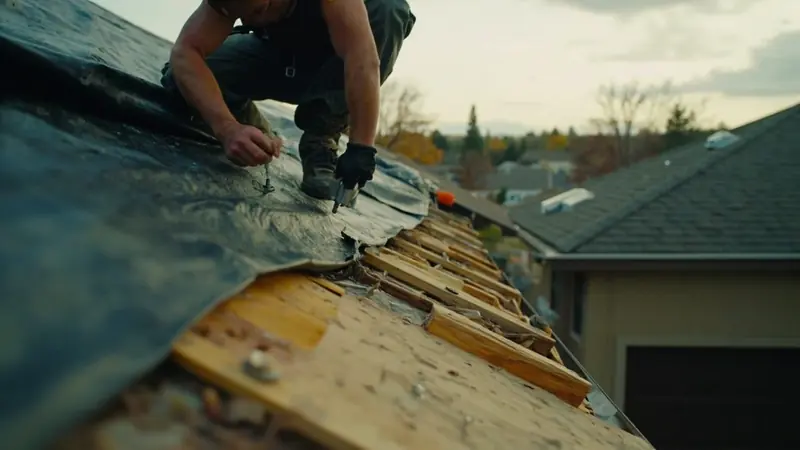
What a torn shingle or roof hole means right now
Wind or hail tears a shingle loose, and emergency roof tarping is the stopgap that keeps rain out until the roof gets fixed for good. A roof hole after storm damage lets water run along the rafters before it ever shows on the ceiling, so what you see inside is rarely right under the opening itself. That's different from a slow leak that builds over weeks. An opening like this needs a cover before the next round of rain finds it.
- Move everyone out from under a sagging or dripping ceiling and keep that room closed off.
- Set a bucket under the drip, and open one small hole at the low point if the ceiling is bulging.
- Stay off the roof yourself. A wet slope and a ladder in wind are how people get hurt.
A missing tab lying in the yard, a stain spreading across the ceiling, or a strip of shingles the wind carried into the gutter all point to the same opening somewhere on the slope above. A hole in roof leaking after a storm can show up first as a damp smell in the attic, before any ceiling stain appears. If a roof tarp blew off overnight because it was only weighted down with brick or block, the opening underneath keeps taking on water with every gust that follows.
When a storm strips a wide section of the field down to bare decking, that calls for emergency roof work before the next band of rain moves through. If the same wind cracked a window or knocked a section of wall loose, emergency board-up closes that opening while the roof gets tarped.
Santa Ana gusts move through this county in fall and winter, and those downslope winds are what lift a tab loose in the first place. The rainy stretch that follows, running roughly November through March, is what turns that lifted tab into standing water on the deck below it. Streets and storm drains here are built to move water fast, but a roof still shedding water onto that same saturated ground during the heaviest weeks adds to what the foundation is already carrying.
A lifted shingle tab lets wind get under the course above it. In the next storm that whole strip peels back, and the bare deck takes the rain directly, with nothing left between it and the attic insulation. That's the point to call for emergency roof tarping before the next storm band moves through, not after it already has.
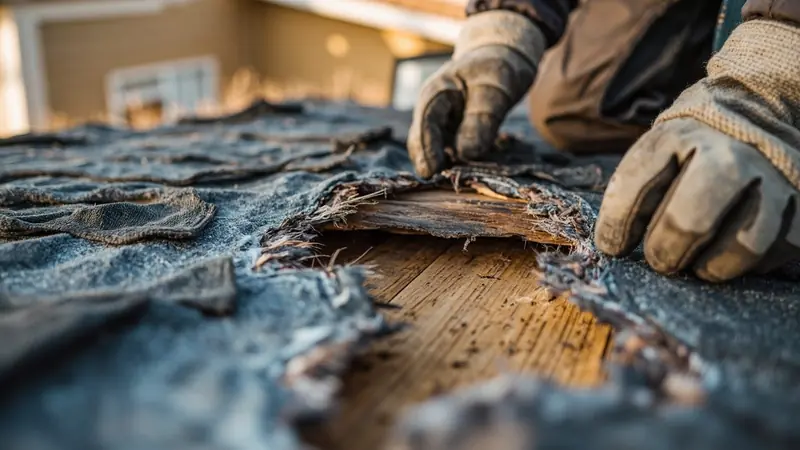
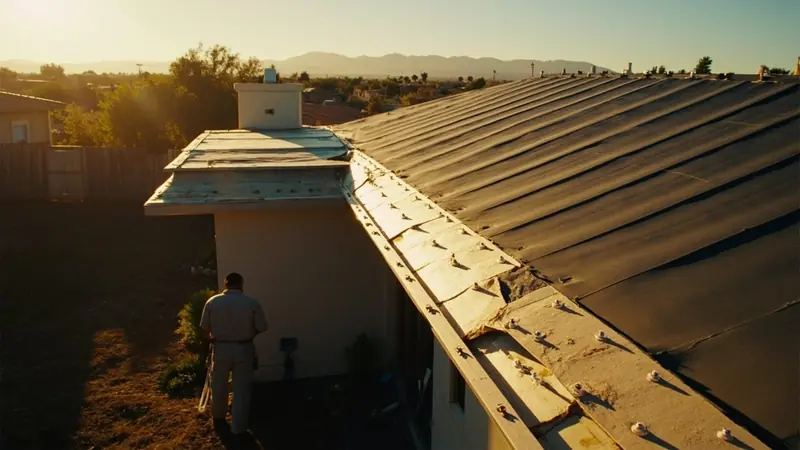
How do I properly tarp a leaky roof?
Tarping a roof right starts inside the house. We trace the stain or the drip back along the rafters first, since water runs sideways under the decking before it drops, and that tells us which section of roof to climb to instead of starting from the yard.
Outside, the order follows how roofs fail: penetrations and boots first, then valleys, then wall intersections, then the open field where the tab let go. A walk test for deck deflection tells us whether the deck under that section is firm or spongy. That single reading decides whether tonight's job is a tarp over roof hole on sound decking or a plywood roof patch where a section has to come out first.
A firm deck under a lifted tab gets a temporary roof tarp pulled over the ridge and battened down on both sides, so wind can't get back under the edge the way it got under the shingle. A spongy deck gets a plywood roof patch set over the open hole before the tarp goes down, so the tarp has something solid to fasten into instead of soft wood.
Roof tarping after storm damage only holds if the edges are fastened, not just weighted. We run the material past every edge of the hole in roof leaking and drive batten strips into solid decking or framing, never into shingles that are already loose.
Before any part gets replaced, ask to see each of these readings.
| Instrument | Good reading | Bad reading | What it changes |
|---|---|---|---|
| Shingle flexibility and granule check | A tab lifts slightly at the corner and the granules stay put | The tab cracks when it is lifted and granules come off in your hand | The asphalt has aged out |
| Ponding check on a low slope roof | The surface is dry and the drains are clear within about two days of rain | Standing water still sitting two days after rain | Loads the deck and works at every seam |
| Infrared scan of a low slope roof after sunset | The field cools evenly as the sun goes off it | Warm patches that hold heat after dark | Wet insulation stores heat that dry insulation has already given up |
| Core cut sample on a low slope roof | The insulation core comes out dry through every layer and the deck under it is sound | A saturated or crushed core | The wet area is larger than the visible stain |
How the emergency tarp visit runs
Finding the opening
We start inside, tracing the stain or drip along the rafters to find which section of roof to climb to, since water runs sideways under the decking before it drops. From there we go up and work from the penetrations outward to the open field, checking the deck with a walk test for deck deflection as we go. You can watch from the yard or the attic hatch while we mark the firm sections apart from the soft ones. By the time we come down, we can point to the exact course or penetration that let go and tell you whether the deck under it held.
Setting the tarp
You see the damage and hear the finding before anything goes up. If the deck held under the walk test, the tarp goes straight over the ridge and down past the damaged course, battened on both edges into solid wood. If a section gave way instead, a plywood roof patch goes over that spot first, cut to bridge solid decking on every side, and the tarp goes over the patch. Either way, nothing gets cut or fastened until you have said go ahead on what we found.
Checking the seal
Before we leave, we check the decking at the edge of the tarp with a pin moisture meter. A reading below 15 percent there confirms the tarp line sits on dry wood, not just the patched section underneath. That edge reading matters as much as the patch itself, since it shows the tarp hasn't just pushed the water sideways. We show you the reading, point out where every batten sits, and photograph the covered section for an insurance file before we pack up the ladder.
What a tarp needs to hold through a storm band
Putting the tarp up is temporary work and doesn't usually need a permit. The repair that follows it usually does, and the California Residential Code is the standard the City of Ontario Building Department checks that work against.
Weighting a tarp down with bricks or sandbags instead of fastening it holds until the wind comes through again. A tarp held only by weight lifts at the first gust and leaves the deck exposed through the rest of the storm.
Tarping over a hole without checking what's underneath hides a soft spot instead of fixing it. Rain keeps finding that same section of decking until it's opened up and replaced for good.
A blue tarp roof cover stretched flat across a slope with no battens pools water instead of shedding it, and that standing weight works at the staples holding the edges down.
A single tab or boot that lifted without an opening forming underneath is usually a case for temporary roof patching.
Our crews work to the installation standards of the National Roofing Contractors Association.
What happens once you call
What we ask you first
We ask if rain is already dripping inside, whether anyone is under that section of ceiling, and how wide the opening looks from the yard or the attic. Water already inside, or a section of deck that feels soft underfoot, moves your call ahead of a tab that lifted with no leak yet. Those answers decide how fast the tarp goes up and in what order.
What gets moved inside
Tarping disturbs the attic access and whatever sits under the leak inside the house. Clear furniture and electronics from under the stain or drip before we arrive, and move anything stored near the attic hatch. We go up through the attic first to trace the water, then onto the roof itself, so a clear path to the hatch matters as much as a clear path to the ladder outside.
What decides the tarp size
Access decides more than the size of the hole does. Whether a ladder alone reaches the section, or material has to go up and over a ridge, changes how much time the tarp takes to set. A single lifted tab gets covered fast. A wider strip torn off in the field, or an opening that needs a plywood roof patch first, means more material staged on site. You see the quote in writing before any of that work starts.
What you see on the roof
We show you where the tab lifted or the hole opened, either from the ground with a photo or from the attic where the stain starts. If the deck underneath needs a plywood roof patch before the tarp goes down, we show you that section before it gets covered. You get a clear look at what the storm did and a say in whether tonight's work is a tarp alone or a tarp over a patched section.
Emergency Roof Tarping Questions From Ontario Homeowners
A tarp stops a roof leak only when its edges are fastened into solid wood. Bricks or sandbags hold a tarp in place until the wind picks up again, and then the opening underneath takes on water with every gust. A cover that stops right at the hole leaves an open edge for wind to catch, so the material has to extend past the ridge and past the lowest damaged course. Setting a tarp over a soft deck without checking it first hides the problem, and that section keeps taking on water until it gets opened and replaced.
Start inside by tracing the stain or drip back along the rafters to find the section above it. Press down on the deck to feel for firmness, since a spongy section needs a plywood patch before any tarp goes on. Carry the tarp past the ridge line and past the lowest damaged course, then fasten both edges into solid wood.
Setting a temporary tarp means fastening it into solid wood at every edge, never weighting it down with brick. The cover has to run past the ridge on one side and past the lowest damaged course on the other, so wind can't find an edge to lift. Checking the deck underfoot matters first, since a soft or springy spot needs a plywood patch set before the tarp goes over it.
Trace the leak from inside the attic first, since water travels along the rafters before it drops. That path shows which section of roof to climb to. Clear a path to the attic hatch and move anything stored near it, since the person tarping goes up through the attic before stepping onto the roof. Outside, the deck gets checked for give underfoot. Firm sections take the tarp straight over the ridge and down past the damaged course. Soft sections get a plywood patch set first. Keep the room below the leak closed off and set a bucket under the drip.
Fastening at the edges, not the tarp material itself, decides how long a temporary cover holds through storm cycles. A tarp battened into solid decking on both edges holds through repeated wind and rain, while one held down only by brick or sandbags lifts at the first gust. The rainy months that follow a storm test that fastening more than once, so loose material gives out faster than a battened edge. The tarp is a stopgap until the roof gets a permanent repair.
Why wind timing changes roof tarping in Ontario
Houses built from the 1940s through the 1970s in this part of the Inland Empire carry low pitch roofs that were already worn when the latest round of Santa Ana wind seasons started finding every loose tab. A tarp on one of these roofs has to span a shallower slope, which means water sits longer against the seams if the battens aren't pulled tight. Homes from the 1980s and 1990s carry tile over underlayment that's often reaching the end of its service life, so a lifted or cracked tile usually means the felt nearby is already failing too, not just under the one tile that broke. A tarp on a tile roof has to sit over the battens, not under the tile edges, or it traps water against the one spot it was meant to protect.
The permanent repair that follows an emergency tarp gets checked before new roofing goes back on, since replaced decking and new flashing can't be seen once shingles cover them again. That's why we photograph the open section while it's still exposed, whether or not the repair itself needs a formal inspection. Winter storms from November through March bring most of the year's rain. That is why a roof that sheds water correctly matters so much here.
Emergency Roof Tarping Across Ontario and Nearby Towns
We handle emergency roof tarping across Ontario and in these nearby towns.
Roofing Services Near Ontario
Looking for emergency roof tarping near you in Ontario? Call (909) 330-4661 and we will confirm we cover your street.
Address:
Ontario Roofing, 4335 E Lowell St, Suite G
More Emergency Roofing Services in Ontario
Looking at the attic with a flashlight for a fresh stain or daylight at a nail is something you can do before we arrive. That look tells you there's a problem, not how far it runs or whether the deck held under it. Walking the slope, lifting shingles, and setting the tarp itself call for fall protection and belong to the visit.
Know when the leak or the missing shingles started, and what the wind or storm was doing right before it happened. If you can, check the attic for how far the stain has spread and note whether anyone is in the room below it. Finding the attic hatch ahead of the call speeds up where we start.