
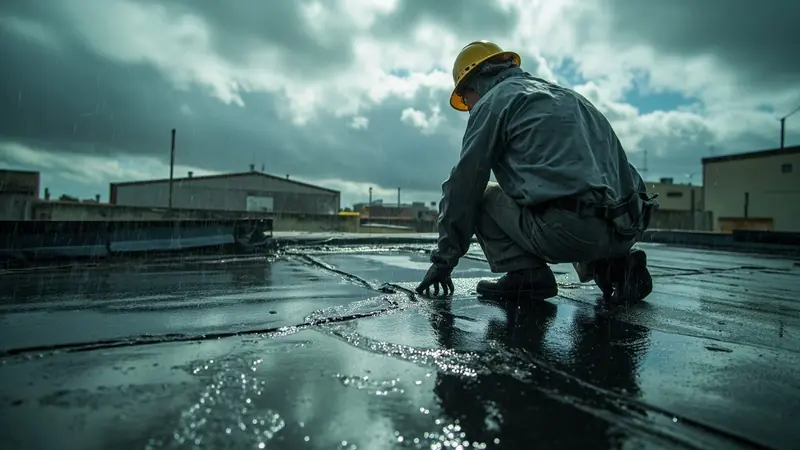
Can a leaking commercial roof wait until morning?
A commercial roof leaking during storm should not wait, because the water moving inside the roof is already past the spot where it entered. Emergency commercial roof repair in Ontario means finding that path before the ceiling below takes on more water.
- Move people and stock away from any ceiling that is sagging, staining or dripping.
- Shut off power to lights or equipment near the leak before anyone touches a fixture.
- Set a container under the drip and move inventory or equipment clear of the wet area.
The signs are usually a stain spreading on a ceiling tile, a drip that keeps going after the rain stops, or a damp smell near a wall that backs up to the roof. On a flat roof, the hole you can find from the hatch is rarely where the water got in. Ontario's winter storms run from about November through March and load every seam and drain on a flat roof with hours of standing water at once, and Santa Ana wind events the rest of the year work loose edges and flashing that a seam depends on.
A pinhole at a seam rarely stays a pinhole. Water slips through that gap and moves sideways beneath the membrane, above the insulation layer. It can end up far from the spot visible on the roof. A wet insulation board stops holding heat and the deck under it starts to corrode, often well past where the ceiling first stained. Once water pooling on commercial roof surfaces sits over a seam like that for more than a day, call before the next storm front adds another load to the same section.
We also handle storm damage roof repair across Ontario.


What happens on an after hours visit
On an after hours call to a leaking membrane roof, we start at the roof hatch and look at where water is entering, not only where it shows on the ceiling below. We check the drains and low points for standing water, then walk the field to the seams nearest the interior stain, since a seam sitting under water for hours is the likely source.
An infrared scan of the roof after sunset shows whether the field cools evenly or holds warm patches. A warm patch after dark usually means the insulation under it is already wet. Where the scan flags a section, a core cut or a moisture meter confirms it before anything gets opened for a membrane roof patch repair.
What decides whether tonight's fix is a patch or a larger section cut out is how far the wet area runs once we open it. A clean cut around a pinhole and a hot air welded patch can get the opening closed and the water stopped the same visit. A board that comes up saturated for several feet past the hole means that run of membrane and insulation has to come out, not just the hole itself. This is the point in a commercial roof emergency service where the deck decides the job.
Many of the roofs we reach for this work are TPO single ply membrane, either mechanically attached or fully adhered, with seams that are hot air welded and a white reflective surface. It is sold in thicknesses commonly quoted as 45, 60 and 80 mil, and the heavier sheet holds up better against foot traffic, including other rooftop work that puts people back on that section of roof later.
A roof that keeps reopening at the same seam after repeated patches usually has a membrane that has aged past the point a patch holds, which points toward replacing that run rather than patching it again.
A newer roof with one bad seam is a different case, and a welded patch on sound membrane around it can carry the rest of the sheet. Either way, the finding from the scan and the core sample goes into a written quote you see and approve before any cutting goes past the test opening.
After severe weather, FEMA's guidance on documentation makes the difference in how smoothly a claim goes.
How the after hours repair runs
Finding the wet section
We start at the roof hatch and the drains, then run the infrared scan after dark across the field near the interior stain. A warm patch on the scan gets confirmed with a core cut or a moisture meter before we call it. You see the scan results and the core sample as we go, and we walk you through what the warm area and the saturated core mean for that part of the roof. This step ends with the cause named and a written quote in your hands for either a patch or a larger cut out.
Patch or cut out
Once you approve the quote, we isolate the wet section first, cutting back to where the insulation tests dry. A pinhole seam with a short wet run gets a hot air welded patch over new membrane. A longer saturated run gets that section of insulation and membrane replaced instead of patched. We pause at that cut line and show you the board coming out before any new material goes down, so you see exactly how far the damage went.
Checking the seal before we leave
Before we leave, we check the new seam and the exposed decking with a pin moisture meter. A reading under 15 percent on the decking tells us that section is dry and the seal is holding. We show you that reading and the welded seam itself, and the wet section is marked so a follow up visit can confirm it stayed dry through the next rain.
What this repair needs to meet in Ontario
Replacing a section of commercial membrane usually needs a permit, and the City of Ontario Building Department reviews work like this before the roof closes back up. A patch sealed with tape instead of a hot welded seam holds through a dry week and opens the first time wind gets under the edge, since gusts moving through the valley lift a loose membrane edge the same way they lift a loose shingle tab on a house roof.
A warehouse roof leaking badly after one of these wind events usually traces back to a seam that was taped rather than welded, or a drain that stayed clogged through the storm. Parapet wall roof repair gets skipped the same way. Counterflashing left loose at the wall lets wind driven rain get behind it even when the membrane across the open field is sound. That leak shows up inside a wall two floors down with nothing visible on the roof above it.
If you are still sorting out the cause, start with ponding water on flat roofs.
What the after hours call covers
Tonight or next visit
During the call, we ask if water is pouring in right now. That same call covers whether it is pooling over stock, equipment, or a sagging ceiling. An active leak over inventory or electrical equipment usually means someone comes out tonight. A slow drip into a container with nothing below it at risk can often wait for a scheduled visit instead, and we tell you which one fits what you describe.
What the visit disturbs inside
Reaching a leaking seam from inside usually means pulling back a section of ceiling tile or insulation to see where the stain is spreading from. Clear anything stored directly under the wet area and move equipment away from that spot before we arrive. On the roof itself we open only the section the scan and core sample point to, and that opening gets closed the same visit.
Factors in repair size
Cut up roofs with curbs, drains, skylights and parapet walls take longer to check and repair than an open field. Each penetration is a seam that can fail on its own. How far the wet insulation runs once we open the membrane decides whether this stays a patch or becomes a larger section replacement. You see the finding and approve the written quote before anything beyond the test opening gets cut.
What you see and decide
We show you the scan results and the core sample on the spot, including how far the wet section runs past the visible hole. You see the options, patch the seam or cut out the wet run, before either one starts. Anything removed, including a saturated insulation board, gets shown to you before it goes in the trailer, and you approve the quote before we go past the test opening.
Emergency Commercial Roof Repair Questions From Ontario Businesses
Equipment stored on a flat roof gets moved clear before we open the membrane. It stays away from the section the scan and core sample point to. Walking a wet, saturated membrane can press a soft board in further, so we stay off that area until it is cut and dried. Rooftop equipment near curbs or penetrations gets checked too, since each one is a seam that can fail on its own. Clearing a path around the work area lets the cut out happen without extra foot traffic on membrane that is already compromised.
A ceiling stain can keep showing after the leak is sealed because the insulation and ceiling material above it are still holding water that has to dry out. The membrane stopping new water from entering doesn't dry what already tracked sideways into the board. We check the exposed decking with a pin moisture meter, and a reading under 15 percent tells us that section is dry. Until it drops below that, the stain may darken or spread slightly as trapped moisture works its way through, even with the roof already closed.
Moving stored material off a flat roof is safe if the path stays clear of any section that feels soft or wet underfoot. A saturated membrane can press a wet board in further under extra weight. Clear the path to the stock or equipment first, then move it without walking across the stained or low-lying area. Material pulled off a dry section of membrane doesn't add risk. The damage comes from foot traffic on membrane that is already holding water, not from relocating the stored items themselves.
Drain strainers usually clog again from leaves, grit and roofing debris rather than mineral buildup. A flat roof drain sees runoff, not standing water long enough to leave mineral scale. Clearing a reachable strainer without stepping onto the membrane is a check a building manager can do between storms. What changes that is a low point holding water for more than a couple of days, which points to a clogged line past the strainer or a slope issue the repair visit has to check with a core sample and scan.
A welded patch looks different at first because new TPO membrane comes in a bright white reflective sheet that stands out against a roof that has weathered and dulled over time. The seam itself is hot air welded rather than taped, so the edge looks fused rather than just stuck down. Over time sun and weather dull the new section until it blends closer to the surrounding membrane. Thickness can also differ, since TPO is sold in 45, 60 and 80 mil sheets, and a heavier patch reads slightly thicker at the seam edge.
Why Ontario's storm months change a flat roof repair
Ontario and the wider San Bernardino County valley get most of their yearly rain between November and March. That rain lands on every flat commercial roof at once instead of soaking into ground the way it does under a yard. A clogged roof drain cannot clear itself no matter how well built the roof is. Regular drain checks catch blockages before they cause leaks or backups. Santa Ana wind events outside those storm months add a second load, working loose flashing and membrane edges the rest of the year. A seam that held through a dry summer can open the first time a storm sits over the valley long enough to pool water against it.
An inspector checks a replaced membrane section and its flashing before the roof is signed off, mainly the welded seams and the terminations at walls and curbs. That review is why a repair gets documented as it happens rather than covered over, since a weld that looks sound on the surface can still be checked for how it was finished at the edge. Sequencing the cut out, the dry out and the new weld in that order is what lets the inspection happen without opening the roof twice.
Emergency Commercial Roof Repair Across Ontario and Nearby Towns
Our Ontario crew also covers these towns for emergency commercial roof repair.
Roofing Services Near Ontario
Looking for emergency commercial roof repair near you in Ontario? Call (909) 330-4661 and we will confirm we cover your street.
Address:
Ontario Roofing, 4335 E Lowell St, Suite G
More Emergency Roofing Services in Ontario
A homeowner or building manager can clear a roof drain strainer if it is reachable without stepping onto the membrane itself. Stop at the roof hatch, because a wet membrane is slick and walking on a soft, saturated section can press a wet board in further. Cutting back to dry insulation and welding a new seam belongs to the visit.
Know when the leak started and what changed just before it, such as a storm or a wind event. If you can, note where the stain is on the ceiling and whether it is spreading or holding steady. Any age you have for the roof and where the roof hatch is helps, along with whether anyone is working under the wet area right now.