

Flat roof repair for buildings with parapets
A commercial flat roof rarely fails across its whole surface at once. Most flat roof repair work targets one failed seam, a cracked pipe boot, or a drain that has stopped moving water off the field. Inside the building that shows up as a brown ring on a ceiling tile, a damp wall below the roof line, or a bubbled patch on the membrane. Flat roof bubbling like that usually marks trapped moisture under the sheet, and commercial roof inspections before storm season catch it while it is still one spot.
Some callers describe a brown ring that only shows up when wind drives rain from one direction, which points at a wall flashing or a penetration rather than the open field of the roof. Others ask how many years a roof like this has left, or say they keep patching the same spot and it keeps coming back.
A patch that fails next to the last patch is a sign the membrane around it has aged past the point where a seam will hold, and that moves the conversation toward a wider commercial roof replacement instead of another patch. Flat roof leaking behind a parapet usually traces back to a seam or a drain.
A tiny puncture in a flat roof's seam can carry water sideways beneath the membrane. That moisture then moves through the insulation rather than dripping straight below the hole. A board soaked that way loses its insulating value, and the deck under it can corrode well past where the surface damage shows. Flat roof standing water sitting on top of that same spot adds weight day after day. That is why a small leak and a ponding problem often turn out to be the same job.
Debris left behind by a Santa Ana wind event or a stretch of winter rain often settles over a drain or scupper, backing water up against a seam that was already thin. Bubbling with no storm, or water pooling in one spot two days past the last rain, means call instead of waiting. Left alone, that wet section spreads sideways under the membrane before the deck under it shows any sign from inside the building.
If the issue sits elsewhere in the building, read about EPDM flat roofing.
The CSLB License Lookup publishes the rules that govern work like this in your area.
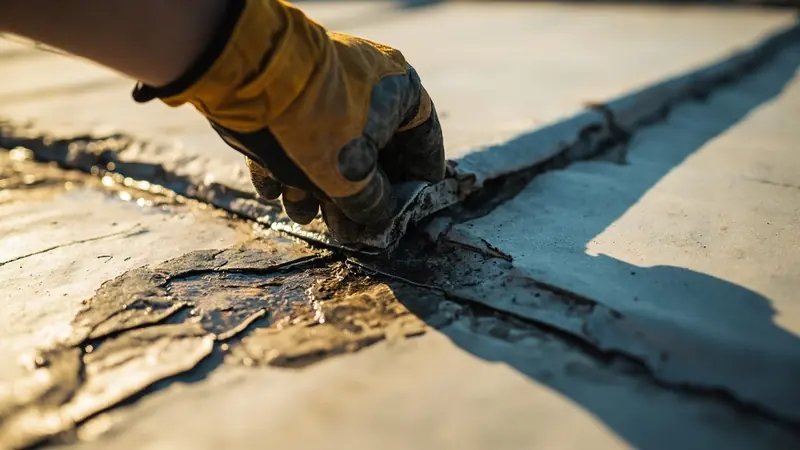
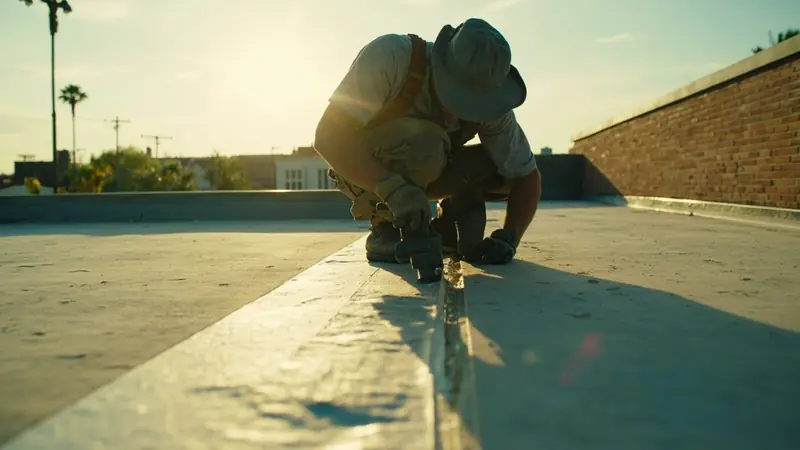
Repairing or replacing your flat roof
Low slope roof repair work like this starts by finding where water enters, which the inside of a building rarely shows clearly on its own.
- We check scuppers and drains for debris and confirm water is reaching them.
- We mark any spot still holding water two days after the last rain.
- We look at seams and terminations for an open edge or a failed weld.
- We scan the roof after dark for warm patches that hold heat into the evening.
- We cut a small core sample where the scan or the ponding points to a problem.
- We check the deck under that core for soft or wet wood before closing the hole.
The core sample tells us whether that section of decking is dry or whether it has started to corrode under the membrane. A seam that still welds clean and a deck that comes up dry point to a flat roof leak repair at that one spot. A core that comes out soft, dark, or soaked points toward replacing that section of decking, since patching new membrane over wet boards only traps the problem underneath.
A recover, which welds new membrane over the old sheet without pulling it up, can look like the faster option, but it hides whatever is happening to the deck underneath. On a roof where ponding has already been sitting, that hidden condition is exactly what decides whether a patch holds. A tear off that exposes the deck first takes more steps, but it is the only way to know what is under the membrane before new material goes down.
Where a flat roof membrane repair calls for a new section of sheet, TPO single ply is the usual choice on a roof like this. It comes mechanically attached or fully adhered, with seams welded by hot air rather than glued, and a white reflective surface that sheds summer heat better than a dark membrane.
Buyers often compare it by thickness, commonly 45 mil, 60 mil, or 80 mil, where the heavier sheet resists foot traffic and punctures better. Mechanically attached sheets anchor through the insulation into the deck, which suits a roof with solid decking throughout. A fully adhered sheet glues to the insulation board itself, a better fit where the deck has already needed patch work and an installer wants to avoid new fasteners through it.
We also handle industrial roofing service for businesses in Ontario.
How the repair visit runs
Finding the leak
We start at the roof access point and walk the field, marking any spot still holding water and checking each drain and scupper for blockage. From there we check seams, terminations, and any penetration near the stain you reported, then confirm with an evening scan and a core sample where the readings point to a problem. You see each mark we make on the roof and the core we pull, not just a report afterward. By the time we're done, we can tell you whether that section of decking is dry or wet, and the written quote reflects exactly what we found underneath.
Repairing or replacing that section
Once you approve the job, we open the failed seam or the affected section first and set aside anything reusable, such as flashing that is still sound. A dry deck gets a new weld or patch tied into the surrounding TPO. A section with wet or soft decking gets that board replaced before any membrane goes back down. We pause there so you can see the old board before it leaves the site. The repair ties back into the existing field with a welded seam, matched to the thickness already on the roof where that's possible.
Checking the finished seam
Before we close up, we run a pin moisture meter against the decking we just repaired or replaced. A reading under 15 percent reads as dry, and that has to show before the membrane goes back down for good. We show you that reading on the meter itself, along with photos of the repaired section before the final weld covers it, so you have a record of what the deck looked like underneath. That same number goes into the written quote we leave with you, next to the area it came from.
What flat roof repair needs in Ontario
A flat roof repair job like this usually needs a permit, reviewed by the City of Ontario Building Department under the California Residential Code where it applies, and that office decides what the permit requires once decking is opened and the work is clear. A repair that stays on the surface, such as a single seam weld, is treated differently from one that replaces sections of decking.
Welding a new TPO seam over a section of deck still damp from a recent storm leaves a weld that looks sealed but never fully bonds. It opens again the next time rain sits on it. Skipping a check of the scupper or drain before closing a patch lets wind-blown debris collect right over the repair, turning what should have been a simple flat roof drain repair into the same ponding problem again.
Reusing old flashing at a new seam instead of replacing it leaves a joint that moves with the membrane around it but not with it, which is where the next leak usually starts. A seam welded during the hottest part of a summer afternoon can look fine going together, then separate slightly as the membrane cools and contracts overnight. Scheduling seam work for cooler hours, rather than the glare of midafternoon, matters more here than the brand of membrane being welded.
If you are weighing options, start with how long does a roof last.
How a flat roof repair call works
Deciding when we come out
During that phone call, our team asks if water is currently dripping inside and if rain keeps falling outside. Active dripping over equipment or inventory usually brings someone out today. A ceiling stain with no active dripping and dry weather ahead usually gets a scheduled visit instead. Either way we ask what you can see from inside and whether that spot has been patched before, since repeat patching changes what we bring to the visit.
What the repair disturbs
A flat roof repair usually stays on the roof itself, but reaching a seam or drain sometimes means moving rooftop equipment or stored items near the work area first. Clear a path to the roof access point and move anything stored against the parapet if you can. Inside, we may need access to the ceiling area below a stain to check for soft framing. Nothing below the roof deck gets opened unless water has already reached it.
What the decking decides
The biggest unknown on this job is what the decking looks like once a bad section of membrane comes up, and nobody can judge that from the ground. A dry, firm deck under a failed seam keeps the work to a flat roof seam repair at that one spot. A soft or soaked board found underneath widens the job to that section of decking, not the whole roof, unless nearby core samples turn up more wet boards. You see the job in writing once the decking is checked, and you approve it before any membrane goes back down.
What you see before closing
We show you the ponding marks, the core sample, and any soft decking we find before it goes in the trailer, not just a verbal description after the fact. If the finding points to more than the one spot you called about, we walk the roof with you and point to each area in question. You decide whether a wider section gets opened this visit or gets planned for a later one, and nothing on the roof gets closed up until you have seen what was underneath it.
Flat Roof Repair Questions From Ontario Businesses
A dry deck that still welds clean usually gets a repair at the one failed spot. Replacement enters the conversation when a patch fails next to an old patch, since that pattern means the membrane around it has aged past holding a seam. A core sample taken where water pools or where an evening scan shows a warm patch tells you which situation you have. The decking condition under that core, not the size of the stain on the ceiling, is what decides between the two.
How long a membrane lasts depends on how many times it has been patched or recovered and whether water has been sitting on it. Ponding that stays two days after rain loads the deck and works at every seam, which shortens the life of a section faster than age alone. A membrane welded during a hot afternoon can separate as it cools overnight, which also shortens its life. The core sample and the drain check during a visit show which stage a given roof section is in.
TPO single ply is the usual membrane choice on a low slope roof repair like this. It comes mechanically attached through the insulation into the deck, or fully adhered by gluing to the insulation board, and seams weld with hot air rather than glue. Which attachment method fits depends on whether the deck underneath is solid or has already needed patch work.
Welding new membrane over the old sheet, called a recover, is possible and skips pulling up the existing roof. The tradeoff is that it hides whatever condition the deck is in underneath, which matters most on a roof where ponding has already been sitting.
A soft spot usually means the deck underneath has gone soft or wet, not that the membrane itself failed first. Water from a pinhole seam can track sideways between the membrane and insulation before it ever shows as a hole, soaking a board that then loses its insulating value. A core cut at that spot shows whether the wood underneath is sound or has started to corrode.
Rooftop equipment can cause a leak by sitting near a seam or penetration that gets disturbed when the unit is moved or serviced. Reaching a seam or drain for repair sometimes means moving equipment or stored items near the work area first, which is part of why access matters before work starts. The seam or flashing around a unit's base is where a leak from this cause usually shows, since that joint takes the most foot traffic and vibration over time.
Wind-driven leaks usually point to a wall flashing or a penetration rather than the open field of the roof. A brown ring that only appears when wind drives rain from one direction means water is entering at a vertical surface, like a parapet wall flashing, where normal rain falling straight down would not reach it. Checking seams and terminations near that flashing, rather than the field of the membrane, is where that kind of leak gets traced.
A parapet wall sends water out through a scupper cut through the wall rather than off an open eave the way a gutter would. Checking that the scupper is clear comes before any work on the membrane itself, since a clogged scupper can look like a membrane failure from inside the building when the real issue is blocked drainage.
Why Downtown Ontario parapets change flat roof repair
Downtown Ontario's older storefronts and small commercial buildings, many from the turn of the century through the 1940s with some 1950s infill, were often built flat behind a parapet wall rather than with a pitched roof facing the street. Many of those roofs still carry their original plank or spaced board sheathing under whatever membrane has been layered on since. That construction changes how a flat roof repair goes, because a tear off on one of these buildings usually turns up deck and drainage work that a newer slab-built roof would not need. A scupper cut through a parapet wall, not a gutter, is how water leaves a roof like this, so a blocked or undersized scupper backs water up against the same seams and corners every time it rains instead of draining off an open eave. Repair work on these roofs starts by confirming the scuppers are clear before anything on the membrane itself gets touched.
Flat roof repair that opens decking on a building like this gets inspected at the point the old roof is off and the boards are exposed, before any new membrane closes them back up. That is the stage where plank or spaced sheathing either passes as sound or gets flagged for replacement. It is the only point anyone can see the full condition of a roof that has been patched and re-covered more than once. Scheduling a repair during a stretch of dry weather, rather than mid storm, gives that stage room to happen without water sitting on open decking overnight. Leaving the schedule that tight is part of why a repair on an older downtown roof takes longer to plan than one on a newer slab building.
Flat Roof Repair Across Ontario and Nearby Towns
Flat roof repair calls reach us from all over the Ontario area, including these towns.
Roofing Services Near Ontario
Looking for flat roof repair near you in Ontario? Call (909) 330-4661 and we will confirm we cover your street.
Address:
Ontario Roofing, 4335 E Lowell St, Suite G
More Commercial Roofing Services in Ontario
- EPDM Flat Roofing
- Commercial Roof Repair
- Commercial Roof Replacement
- Commercial Roofing Contractors
- TPO Roofing Systems
- PVC Roofing Installation
- Modified Bitumen Roofing
- Built-Up Roofing Systems
- Roof Coatings & Restoration
- Commercial Metal Roofing
- Commercial Roof Maintenance Plans
- Commercial Roof Inspections
- Industrial Roofing Services
- Multi-Family & Apartment Roofing
- All commercial roofing services
- Wind Damage Roof Repair
- Storm Damage Roof Repair
- Emergency Roof Repair
From the ground, you can zoom a phone camera on the scupper outlet and the wall below it to check for a dripping stain or packed debris. That tells you whether a drain is blocked without anyone going up. Pulling back a membrane, checking a seam weld, or opening decking to see what's underneath belongs to the visit, since that work means standing on a roof that may already be carrying standing water.
Before you call, know whether water is actively dripping inside or just staining, and when you first noticed it. If you know roughly how old the roof or its last membrane is, have that ready too. It helps to know where the nearest roof access point is and whether the building is occupied during the day, since that affects when we can get up there.