
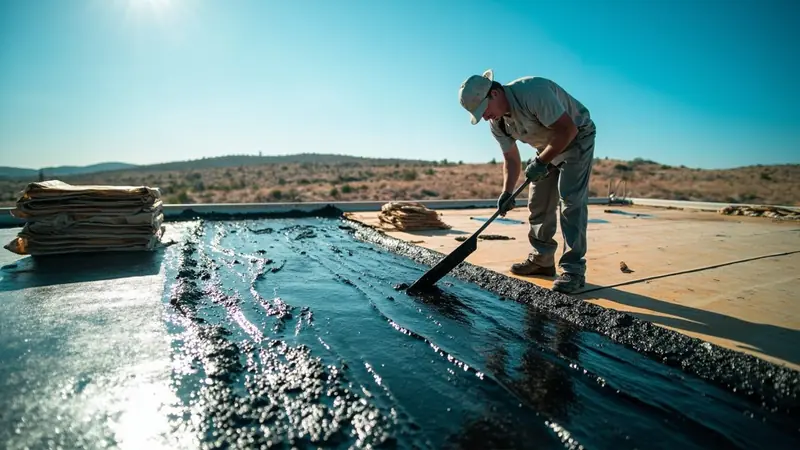
What is a built-up roofing system?
A built-up roof is several layers of felt laminated together with hot bitumen, then finished with gravel surfacing or a cap sheet. Built-up roofing systems spread the waterproofing across that stacked base sheet layer instead of relying on one single membrane. Commercial buildings across the Inland Empire often carry this kind of roof, since a flat or low slope deck suits a layered system better than a single sheet. A leak in one of those plies can sit for weeks before it ever reaches the ceiling below.
Gravel loss on roof surfaces often shows first at the edges and near drains, where foot traffic and wind wear the stone thin. A blistering roof surface looks like raised bubbles where trapped moisture pushes the plies apart in afternoon heat. Cap sheet installation that has lifted at a seam lets rain sit against the felt underneath it. A built-up roof leaking rarely drips straight down from the opening, since water follows the lowest ply before it finds a way through the deck. A leak that only shows up during wind driven rain usually points to an open seam on the windward side.
A pinhole at a flat roof seam is small enough to miss from a ladder. Water tracks sideways between the membrane and the insulation below it, spreading well past the opening itself. A board that stays wet loses its insulating value, and the deck under it corrodes far from the hole you can see on the surface. San Bernardino County's rain arrives across a few wet months each year, and that is when a slow leak like this gets the most water to work with. Summer heat cycles work the opposite way, drying the top of the membrane fast enough that the wet layer underneath stays trapped longer.
Owners sometimes ask how many years a roof like this has left, especially after patching the same spot more than once. Repeated patches in one corner usually mean the plies around it are drying out and losing flexibility, not that the last patch failed. A roof patched several times in the same area is already pointing at where the next leak will start.
A ceiling stain that stays the same size after a dry week usually means the water already drained and dried out. A stain that grows after each rain, or returns within days of a dry patch, means water is still moving under the plies. Once a ceiling tile feels soft or a light fixture shows rust at its edge, that is the point to call before the next storm reaches that section.
The CSLB License Lookup publishes the rules that govern work like this in your area.


How we repair or replace a built-up roof
Every visit starts by finding where water is moving under the membrane before any tool touches the roof.
- Walk the roof and check for ponding water at drains and low points.
- Scan the surface after sunset for spots that hold heat longer than the field around them.
- Cut a small core sample at any warm spot to see what the layers hold.
- Check the base sheet layer and the plies above it for moisture through the stack.
- Inspect seams, flashing and cap sheet installation for open laps or lifted edges.
The core is what decides the repair. A core that comes out dry through every ply, with a sound deck underneath, usually points to a patch at that seam. The rest of the membrane stays in place. A core that comes out saturated, or crumbles under a crushed layer, means the wet area reaches further than the stain shows. Patching the surface alone will not dry out what sits underneath.
At that point the choice is between built-up roof replacement with new plies and a cap sheet, or a switch to EPDM rubber membrane. EPDM flat roofing comes as a black rubber sheet with seams taped or glued. It stays flexible through cold nights better than a hot tar roof. A fully adhered EPDM sheet suits a roof with many penetrations, while a ballasted EPDM layer works on a wide open field with fewer seams. A building with heavy rooftop foot traffic across equipment pads often does better staying with a tar and gravel roof, or switching to modified bitumen roofing. Both hold up to wear better than exposed rubber.
Our crews work to the installation standards of the National Roofing Contractors Association.
Steps in a built-up roof visit
On site assessment
On site, we walk the roof field and check the drains and low points for standing water. We scan the surface after sunset if conditions allow, then cut a core sample at any spot that reads warm or looks suspect. You see the core pulled out and what it looks like through each layer. We also check the flashing, seams and cap sheet installation around any penetration near the stain. By the time we are done, we can point to the exact ply or seam that let water in. That finding goes into a written quote before anything else happens.
Repair or tear off
You approve the quote first, then we isolate the wet section before any new material goes down. A small area gets cut back to dry decking, then built up again ply by ply with a new base sheet layer and bitumen. It finishes with a fresh cap sheet or gravel surfacing roof. A roof with multiple failed layers gets a full tear off instead, down to a sound deck. Every old layer gets hauled off before the new system starts. The work pauses at that tear off point so you can see what the deck looked like underneath.
Final check
Before we leave, a pin moisture meter gets run against the deck at the patched or replaced section. A reading under 15 percent reads as dry decking and clears that area to close. Anything higher sends us back into that section before the new plies go down over it. We show you that reading, along with the new seams and flashing details. You see what is sealed under the new surface before it goes back into service.
What built-up roof work needs in Ontario
A tear off and recover on a low slope commercial roof typically needs a permit before work starts. The City of Ontario Building Department handles that review for buildings in the city, under the California Residential Code where it applies to the structure.
A few shortcuts cause trouble on this job. Installing a new cap sheet over a base sheet layer that never dried out traps moisture under the new plies. The blistering starts again within one heat season. Stripping only the top gravel surfacing roof layer, and leaving old seams unchecked below, misses the real leak path. Water already moved sideways under that layer. Patching one seam without checking the flashing at a nearby wall or curb leaves the same water a new way in.
Most of Ontario's rain falls across a few months each winter, and that is when ponding sits longest on a slow draining roof. A roof drains slowly through summer heat. Repeated winter rain on top of that is what shows up as a soft core at the next visit, the same core cut and layer count that gets written into the quote before any tear off starts.
A building with several low slope sections under one roof, such as an apartment block, is different. It needs multi-family and apartment roofing scheduled across more than one section at a time, since drains and parapets differ from section to section. A rooftop near heavy kitchen exhaust or chemical venting usually calls for PVC roofing instead of a bitumen system. PVC resists grease and solvents better than tar does.
What this job asks of your building
Active leak or scheduled check
On the call we ask whether water is coming through a ceiling or light fixture right now. We also ask how large the stain or ponding area looks from a window or the ground. An active leak during a storm usually calls for a visit that same day. A slow stain with no active drip, or gravel loss on roof with no leak yet, can often wait for a scheduled visit. The deck underneath is not taking on new water yet.
What the visit disturbs
Reaching a built-up roof means setting up access to the roof itself, whether by ladder, lift or an existing roof hatch. Any rooftop equipment near the work area, such as vent stacks, gets worked around rather than moved unless it blocks the repair. Inside, a ceiling tile or two may come down to trace a stain back to its source. Clear the area under any known stain and keep parking near the building open for equipment.
Repair, recover or full tear off
How many layers of old roofing have to come off and get hauled away is the biggest factor in the size of this job. A roof with one layer of felt and gravel is a smaller job. A roof with two or three layers stacked up from past recovers is a bigger one. The core cut taken on the visit shows how many layers are up there, since that is never obvious from the ground. You see the finding and the quote in writing, and you approve it before any tear off starts.
What you see and approve
We show you the core sample and point out where it was pulled from on the roof. The options for that spot, patch, recover or full tear off, get explained in plain terms before any decision is made. Nothing gets opened up or torn off until you say go ahead. Any section of old decking or soaked insulation that comes out gets set aside so you can see what sat under the membrane.
Built Up Roofing Systems Questions From Ontario Businesses
A roof built from several layers of felt laminated with hot bitumen, finished with gravel or a cap sheet, counts as built-up. Builders use it on flat or low slope decks, since a stacked layer system handles that pitch better than a single sheet membrane. Commercial buildings around the Inland Empire often carry this type. Each ply adds waterproofing, so the roof depends on the whole stack rather than one surface. Checking that stack means cutting a core sample to see what each layer holds.
Neither type is better outright, since they solve different roof shapes. Built-up systems suit flat or low slope decks where a single shingle layer would not shed water correctly. Shingles work on a pitched deck where gravity moves water off fast. A flat roof needs the stacked ply design to spread waterproofing across a surface with little slope. Choosing between them comes down to the deck's pitch, not which material performs better in general.
Lifespan depends on how many heat and rain cycles the plies have absorbed and whether past patches trapped moisture underneath. Dry, flexible plies with a sound deck hold up longer than a roof with repeated patches in one spot, since those patches point to plies already losing flexibility. Summer heat softens the asphalt and speeds blistering, while winter rain gets under lifted seams. A core cut at a warm or ponding spot shows whether the layers underneath are still dry.
Built-up roofing is often called a tar and gravel roof, since hot bitumen and a gravel surfacing layer finish the top. Some buildings use a cap sheet finish instead of gravel, but the layered felt and bitumen underneath stays the same construction. The name describes how the roof gets made, one ply laminated over another, rather than a single rolled membrane. That stacked base sheet layer is what separates it from a one piece system like EPDM.
Built-up roofing spreads waterproofing across several plies, so one weak spot does not open the whole roof. That stacked design holds up well under foot traffic near equipment pads, and gravel surfacing shields the plies from sun. On the other side, a leak can travel sideways under the plies for a stretch before it ever shows on a ceiling, and heat cycles can blister an older membrane. A saturated core means the wet area reaches past the visible stain, which changes the size of the job.
Tar and gravel roofing is the common name for a built-up system, since hot bitumen and loose gravel finish the surface. Some versions swap the gravel for a cap sheet, but the base construction, several felt plies laminated with bitumen, stays the same. Commercial and apartment buildings with flat or low slope decks across the Inland Empire often carry this type, since the stacked plies handle minimal pitch better than a single sheet membrane would.
Why Ontario's heat and wind change built-up roofing systems
Ontario sees summer highs climb into the mid 90s F by August, and heat waves push well past 100 F some afternoons. A dark bitumen roof surface runs hotter than the air above it. That heat softens the asphalt in a built-up roof and speeds up blistering roof surface problems on older membranes. Fall and winter bring Santa Ana wind gusts strong enough to lift loose flashing and cap sheet edges. Rain that follows later in the season finds every gap the wind left behind. A roof that drains slowly holds that water longest at low points and around drains. That is why the surfacing and seam detail picked for a roof in this county has to account for both the heat and the wind.
Permit review for this kind of work looks hardest at the deck condition and the number of layers coming off. That is what decides disposal and whether the new assembly meets current requirements. A roof recovered without that review on record can complicate a future sale or an insurance claim. There is no documentation of what sits under the surface. That is one reason the core cut and the layer count get written into the quote before any tear off begins, not after. A building owner who keeps that record has an answer ready the next time someone asks what is on that roof.
Built Up Roofing Systems Across Ontario and Nearby Towns
Built-Up roofing systems calls reach us from all over the Ontario area, including these towns.
Roofing Services Near Ontario
We do Built-Up roofing systems across Ontario and the surrounding area. Call (909) 330-4661 and we can tell you when someone can be there.
Address:
Ontario Roofing, 4335 E Lowell St, Suite G
More Commercial Roofing Services in Ontario
- Commercial Roof Repair
- Commercial Roof Replacement
- Flat Roof Repair
- Commercial Roofing Contractors
- TPO Roofing Systems
- EPDM Flat Roofing
- PVC Roofing Installation
- Modified Bitumen Roofing
- Roof Coatings & Restoration
- Commercial Metal Roofing
- Commercial Roof Maintenance Plans
- Commercial Roof Inspections
- Industrial Roofing Services
- Multi-Family & Apartment Roofing
- All commercial roofing services
- Wind Damage Roof Repair
- Storm Damage Roof Repair
- Emergency Roof Repair
Looking at a ceiling for a brown ring or a soft, sagging spot is something you can check yourself, from inside the building. That tells you a leak exists, not where the opening sits or how far the moisture has spread under the membrane. Finding the exact seam or penetration, and judging whether the deck underneath is still sound, is work for the visit. That takes core cuts and rooftop access most owners do not have.
Before you call, know roughly how old the roof is. Know where the stain or ponding shows, such as near a drain, a wall or a rooftop unit. Note when it started and whether it only happens during rain or wind. If you can see the roof from a window or a taller building nearby, a quick look at gravel coverage helps too.