
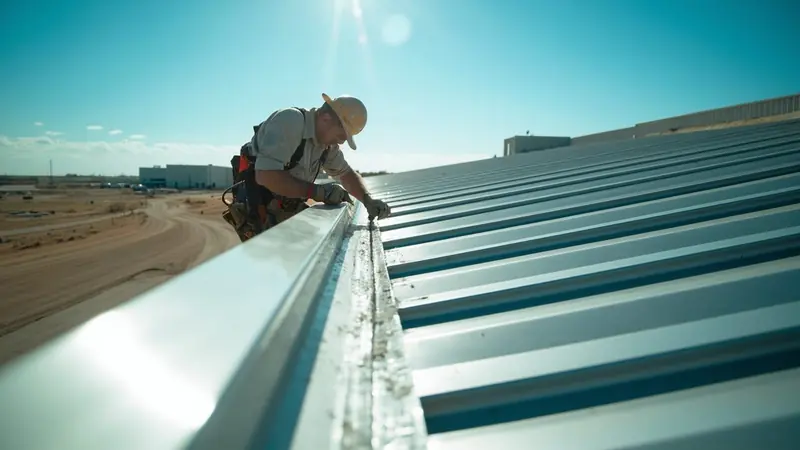
Commercial metal roofing repair or replacement
A flat or low slope commercial building in Ontario depends on commercial metal roofing to keep rain out. The work is in the panels, clips, fasteners and seams. When a metal roof leaking at seams is the complaint, the panel itself rarely failed. It usually means the seam lock or a hidden fastener underneath has opened under thermal movement. Water tracks sideways before it drops through to the deck.
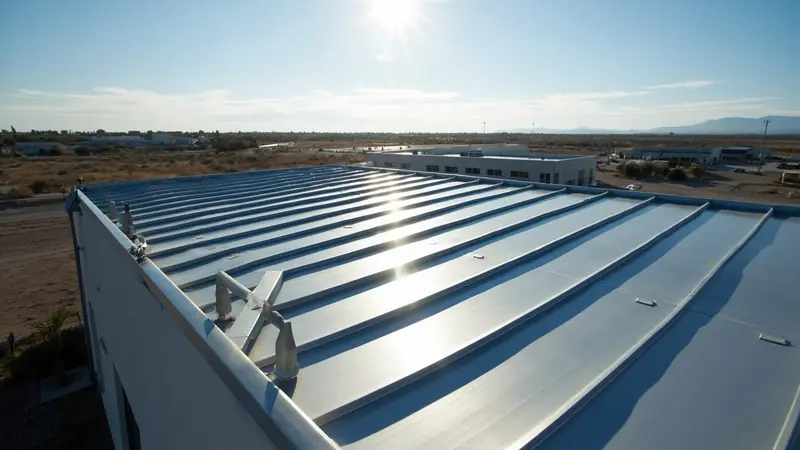
Some buildings in Ontario use a standing seam metal roof, where panels lock together along raised seams and hide the fasteners underneath. Others use corrugated metal roofing panels, screwed down through fastener heads on the flat of the panel. Each system fails differently. A standing seam loses water at the seam lock, while a corrugated panel loses it at a worn fastener or a stripped screw hole. Knowing which system is on your building decides where we look first.
Ontario's summer heat runs into the mid 90s. That daily swing between a hot afternoon and a cool night works at every seam on metal roofing for businesses across the city. Panels expand during the day, and clips have to let them slide. When they do not, fastener holes stretch and seams start to lift. Fall and winter Santa Ana wind events add a second load, pushing hard gusts under any seam or panel edge that already sits loose.
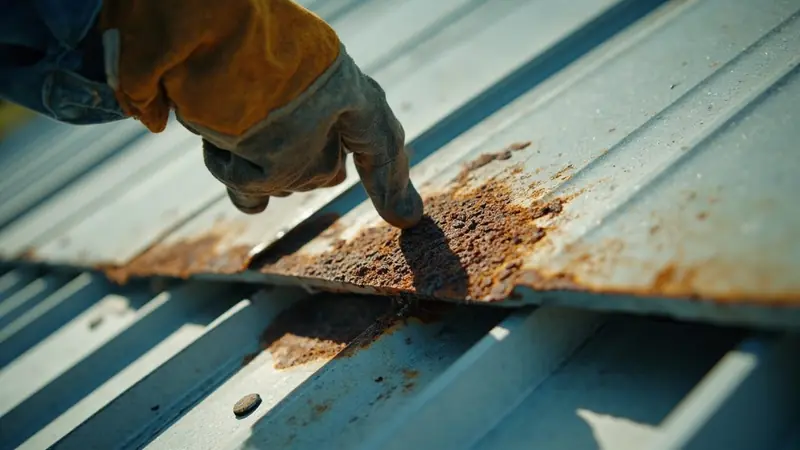
A fastener head or a cut edge where the coating was scored during installation is usually where rusting metal roof panels start. Once rust gets started at one fastener, water can track under the panel to the clip below. That movement runs along metal roof panel seams that were not built to hold standing water. A clip that corrodes stops holding the panel the way it should. On an older low slope section, that shows up as a ceiling stain long before anyone sees it from the roof.
These signs show up on a lower slope section, where water has less pitch to run clear. It sits longer against any lifted seam. A parapet or a wall termination holds wind-driven rain the same way, which is why those joints get checked first. Before a seam lifts enough to see, a metal roof making noise in wind is usually the first sign.
A lifted edge works the same way whether it is a shingle tab or a metal panel. Wind gets under it, works at the next seam or fastener line, and a full section can peel back in the next storm. Once that happens the deck underneath takes rain directly, with nothing left to shed it. If you see daylight at a seam edge, hear ticking or banging in wind, or find a loose panel corner after a storm, that is the signal. Call before the next wind event works the opening wider.
If the building also needs industrial roofing service, that page covers what the work involves.
Before you call, you can read up on metal vs shingle roofing.
How we repair or replace a commercial metal roof
The visit starts inside, then moves outward to the seams, the fasteners and the deck underneath, in that order. Finding the weak point on a commercial standing seam roof starts at the stain, not at the shiny top of the panel. The order matters because what we find at each step changes what we check next.
- We look inside first, tracing any ceiling stain or stain on the roof deck above it back toward its high point.
- We walk the seams and panel edges, checking fastener heads and clip lines for backout or rust.
- We run the walk test for deck deflection, feeling for give between rafters under the panel.
- We check terminations at a parapet or wall, where a panel meets a wall or edge metal.
- We confirm the finding and put the repair or replacement in writing before any work starts.
A deck that still feels firm underfoot, under a covering that is still fastened tight, usually means a repair at the seam or the fastener line. A spongy or springy feel between rafters during the walk test for deck deflection means the decking underneath has delaminated. At that point a panel repair will not hold, because the deck is moving independently of the panel above it.
The deck cannot be judged from the ground or from inside the building. Once the old covering is pulled back at the suspect seam, the decking condition there decides whether the fix stays at that one seam or grows to cover more of the roof. That is the one finding that cannot be known before the panel comes up.
Clips let a panel move as the metal expands and contracts without pulling at the fastener holding it down. A fastener that is screwed too tight, or set without a clip at all, fights that movement every day the temperature swings. That is usually where a seam or a screw hole gives first.
Choosing between a 24 gauge steel panel, a 22 gauge steel panel and an aluminum panel comes down to thermal cycling and ownership length. A lower gauge number means a thicker, more rigid steel panel. That thickness holds up longer under the daily heat swings this city sees. Ontario's hot afternoons and cool nights work a thinner panel's seams harder over time.
That pushes a longer hold toward the thicker 22 gauge steel or toward aluminum. Aluminum does not corrode the way a rusting metal roof panel in steel can. Fasteners hidden under the seam on a standing seam metal roof last longer than exposed screws on a corrugated panel. They are never struck directly by rain or sun.
The CSLB License Lookup publishes the rules that govern work like this in your area.
Pick the two options that fit your building, then ask which one makes sense for it.
| Option | The numbers a buyer weighs | Best suited to |
|---|---|---|
| Standing seam metal | Fasteners hidden under the seam, panels clipped so they can expand and contract with temperature | Roofs meant to be kept for decades |
| Three tab shingle | One layer with cutouts, lighter per square | Low exposure roofs where first cost decides |
| Architectural laminated shingle | Two laminated layers that are glued together so it is heavier and thicker than three tab | Most steep slope roofs on a building |
| Impact rated shingle | Graded by a steel ball impact test where Class 4 is the top step | Hail country and exposed roofs |
Steps for a metal roof visit
Assessment on site
We start by looking at wherever the stain, drip, or lifted seam shows itself, inside or on the roof, and work outward from there. The seam, fastener, and deck checks, including the walk test for deck deflection, happen in the order already covered, and we talk you through what each one found as we go. You see the actual seam or panel in question, not just a number on paper. By the time we are done, the cause has a name, whether that is a clip, a fastener, or the decking underneath, and a written quote is in your hands before we leave.
Approval and the repair
Once you approve the quote, the work starts with isolating the affected area. For a seam problem, that means pulling the panel at the lifted seam and exposing the clip and fastener line underneath. For a deck problem, that means opening the covering back to sound decking before anything new goes down. The repair itself follows. A loose or failed clip, a stripped fastener hole, or a section of panel gets replaced to match the surrounding standing seam metal roof or corrugated panel profile. Work pauses again before any flashing at a termination or a wall gets closed back up, so you can see it before it is covered.
Final check before we leave
Before we leave, we walk the repaired or replaced section again. A deck that feels firm underfoot, with no give between rafters, is what passes. If the job was a full section replacement, we also check that the new panel's seam locks and clips hold the way the rest of the roof does, so one section is not already moving differently than its neighbors. We show you the closed-up seam or termination and the old clip or fastener that came out, so you can see exactly what changed.
What a metal roof needs in Ontario buildings
Replacing a commercial metal roof, or switching to a different panel type, usually needs a permit here. The City of Ontario Building Department reviews work like this under the California Residential Code before it gets closed up. The building owner still makes the call on timing, but the inspection stage is where sheathing and flashing choices get checked against what was approved. That review covers the parts most shortcuts skip, the deck condition and the flashing detail, not just the panel on top.
Reusing old clips under a new panel saves a step on the materials list. A clip bent during the last removal no longer lets the panel float the way it should. The first hot afternoon after that locks the new panel against the very movement the clip was supposed to allow, and the seam above it works loose by the following summer.
Setting fasteners by hand without checking for consistent hold leaves some screws overdriven and some barely snug. An overdriven fastener crushes the washer seal under its head, and that crushed washer is where water gets in first during a wind-driven rain. A fastener left loose backs out faster once the panel starts its daily expansion and contraction.
Running new panels over an old corrugated roof without checking the deck first hides whatever condition is already there. A soft spot found later means pulling panels that were already screwed down, after the work was thought finished. Checking the deck first is part of what that same review is meant to catch.
Skipping flashing replacement at a wall termination or a parapet to save a cut works for one dry season. An old flashing piece bent to fit a new panel profile rarely seals the same way twice. That joint is usually the first place a roof making noise in wind turns into a roof letting water in.
Our crews work to the installation standards of the National Roofing Contractors Association.
What to expect once you call
Today visit or scheduled job
On the call we ask what you can see on the roof or ceiling, such as a stain, a drip, or a loose panel after wind, and whether the leak is active right now. An active leak inside the building moves the visit to today. A noise, a rust spot, or a seam that looks lifted but stays dry can wait for a scheduled visit, which gives time to line up the access and materials needed before anyone gets on the roof.
What gets moved for access
A metal roof job on a commercial building usually means rooftop equipment near the work area gets shifted or protected while panels come off and go back on. Inside, clear the floor space under the main work zone, since a ceiling tile or insulation batt may come down to check the deck from below. Materials get staged on the roof itself when access allows, so a clear path for a dump trailer and a loading area near the building helps.
What drives the job size
The biggest factor on a commercial metal roof job is access for a dump trailer and for material delivery. A building with a clear yard or a loading area lets panels and old roofing move straight off the roof without extra handling. A tight site, blocked by parking, landscaping, or a narrow drive, means staging panels in smaller loads and more trips, which stretches out every other part of the job. You see the access plan and the repair or replacement work in writing, and approve it before anyone starts.
What you see on site
We show you the stain, the lifted seam, or the rust spot where it sits, either on the roof or in photos if the area is not safe to walk. You see the options next to each other, such as a seam repair against a section replacement, before any panel comes off. Nothing gets opened, cut, or pulled until you say go ahead. When a clip or a section of decking comes out, we set it aside so you can see exactly what was underneath before it goes in the trailer.
Commercial Metal Roofing Questions From Ontario Businesses
Panel gauge, clip condition, and how well fasteners resist thermal movement decide how long a metal roof lasts. A thicker panel, described by a lower gauge number, holds up longer under the daily heat swings this climate produces, since it resists the stretching that works loose at fastener holes. Clips that let the panel slide instead of binding also matter, because a clip that fights that movement is usually where a seam or screw hole gives first. Checking fastener heads and seam locks on a visit shows which of these factors is already working against the roof.
A metal roof does not lower value when the panel type, clips, and terminations are matched and installed correctly. Aluminum resists the rusting that steel panels can develop at a scored edge or fastener head, and a standing seam system hides its fasteners from direct sun and rain, which extends how long the seams hold. Problems come from skipped steps, like reused bent clips or flashing cut to fit a new profile. A written assessment of clips, fasteners, and deck condition shows where a building stands.
A lower gauge number means a thicker, more rigid panel, and that thickness holds up better against the daily heat swings this city sees. A thinner panel's seams and fastener holes get worked harder as the metal expands in the afternoon and contracts at night, which is where loosening starts first. A 24 gauge steel panel resists that stretching longer than a thinner option, and ownership length factors in too, since a building held for years benefits more from the thicker panel's slower fatigue at the seams and fastener lines.
Rust starts at a fastener head or a scored edge where the coating broke during installation. This happens long before any water reaches the ceiling below. Once the coating breaks at that spot, rust spreads around the fastener and lets water track sideways under the panel toward the clip holding it down. The leak only becomes visible once that path reaches a low point or a seam, which is why checking fastener heads and seams matters before a stain ever shows.
Foot traffic near a rooftop unit can dent a panel or push a seam lock out of alignment. This risk is higher on a standing seam system, where the fastener sits hidden underneath the raised seam. A dented panel no longer sheds water the way a flat seam does, and a seam forced out of line can open a path for wind-driven rain. Clips are built to let the panel slide as the metal expands and contracts, and repeated stepping near the same spot can stress that clip connection. Checking seams and clips along any access path finds this before it shows as a leak.
A lifted shingle section next to a metal roof matters because wind works the edge the same way on both materials. Once wind gets under a lifted shingle tab or a loose metal seam, it works at the next fastener or seam line. A full section can peel back during the next storm. Where the two roof types meet at a termination, that shared edge is already a point where wind-driven rain collects. A loose tab left unchecked next to a metal panel edge raises the chance that both sections open at once in the next wind event.
Why thermal cycling changes commercial metal roofing in Ontario
Ontario sits in San Bernardino County, where summer highs run into the mid 90s and the ground cools fast at night once the sun drops. That daily swing moves a metal panel more than most other common materials, asphalt shingle or clay tile among them. This is why clip spacing and expansion allowance on a standing seam metal roof matter more here than on a roof with less thermal movement to absorb. The same heat ages down any exposed fastener's rubber or neoprene washer faster, which is why a corrugated panel system, with its exposed screws, needs more frequent fastener checks than a hidden-seam system in this climate. Winters stay mild, so freeze is rarely the driver. The bigger local load on a low slope section comes from ponding after the winter storm season, since standing water sits against any low seam or termination longer than it would on a steeper residential roof.
That review usually applies to a full reroof or a change in panel type, not to a single seam or fastener repair done in place. The inspection point that matters most is the deck. On a low slope section, drainage and termination detail at a parapet or wall get checked too, since an open termination is where a sealed roof above still lets water in below. None of that changes how a single seam repair gets handled, since a small fix rarely triggers the same review a full reroof does. What changes is the order of work: deck condition gets confirmed before new panels go down, not after, so the finding lines up with what gets approved.
Commercial Metal Roofing Across Ontario and Nearby Towns
Our Ontario crew also covers these towns for commercial metal roofing.
Roofing Services Near Ontario
Looking for commercial metal roofing near you in Ontario? Call (909) 330-4661 and we will confirm we cover your street.
Address:
Ontario Roofing, 4335 E Lowell St, Suite G
More Commercial Roofing Services in Ontario
- Commercial Roof Repair
- Commercial Roof Replacement
- Flat Roof Repair
- Commercial Roofing Contractors
- TPO Roofing Systems
- EPDM Flat Roofing
- PVC Roofing Installation
- Modified Bitumen Roofing
- Built-Up Roofing Systems
- Roof Coatings & Restoration
- Commercial Roof Maintenance Plans
- Commercial Roof Inspections
- Industrial Roofing Services
- Multi-Family & Apartment Roofing
- All commercial roofing services
- Wind Damage Roof Repair
- Storm Damage Roof Repair
- Emergency Roof Repair
Checking the ceiling below a known seam or penetration with a flashlight for staining or daylight is something building staff can do between visits. That check stops at the roof edge. Walking a metal panel, lifting a seam, or working near a parapet in wind calls for fall protection, which is where the job moves to a visit.
Know where the sign is happening, such as a stain location inside, a noisy spot in wind, or a loose panel you can see from the ground. Note when it started and what changed just before it, a storm or a hot stretch. If you know the roof's panel type, standing seam or corrugated, or its rough age, have that ready too.