

Storm damage on your roof right now
A missing ridge or hip tile usually shows up two ways: a piece on the lawn, or a neighbor getting a new roof who knocks to ask if you lost tiles too. A roof leak after storm today usually traces back to a seam or joint that opened during the wind.
Stay out of any room where the ceiling is sagging or dripping. Cut power to that circuit at the panel if water pools near a light fixture, vent fan, or smoke detector.
Look at the roofline itself, not just the yard. A lighter, bare patch along a hip or ridge usually marks where a piece came loose. Granules collecting at the downspout outlet point to a shingle that's already shedding its surface. A roof leaking right now will usually show a wet ring on the ceiling that keeps spreading while you watch it.
Summers in Ontario run hot and dry under a Mediterranean pattern, with August highs climbing into the mid 90s F and little rain until winter. Ridge and hip tiles sit in mortar that cracks from daily heat cycling and Santa Ana winds. A joint that's already hairline cracked doesn't need much to let go.
A cracked pipe boot (the rubber seal around a vent pipe) works the same way once it splits. Water tracks down the pipe into the insulation below, then the ceiling stains and the framing around that penetration softens.
A missing ridge cap or an open pipe boot during active rain is an emergency roof situation, not something to leave for a scheduled slot. If the hole is small and the rain has already stopped, temporary roof patching can keep water out until the full repair is scheduled. The sequence that means call today: a few tiles down, then bare underlayment showing, then a ceiling stain spreading past its original ring. That window matters more on a roof with several valleys, where one open joint can drain into more than one bay.
The CSLB License Lookup publishes the rules that govern work like this in your area.

Can you do a partial roof repair?
Yes, a same-day roof repair often stays limited to the ridge, hip or valley section that's damaged, instead of covering the whole roof.
Water travels along the underside of the sheathing before it drops, so a ceiling stain rarely sits directly under the loose tile or shingle. That's why the attic gets checked first, looking at stain position, nail staining and the sheathing itself, before anyone walks the roof surface.
We check the attic first, reading stain position, nail staining and the sheathing with a pin moisture meter. We check pipe boots and other roof penetrations, since that's where most leaks start. We check the valleys, then where the roof meets a wall or chimney. We check the open field for lifted, cracked or missing material. We walk the deck near the opening, feeling for a soft or spongy spot between rafters. We confirm how far the cracking or lifting runs along the ridge or hip.
If the meter stays under 15 percent, the deck below that section is dry and a surface patch holds. A reading over 20 percent tells us water has already soaked into that section, and it needs to come out rather than get covered over. A spongy feel underfoot during the walk test points the same way, even when the meter reading looks borderline. That distinction keeps a patch from going over wet wood, which just traps moisture and fails again.
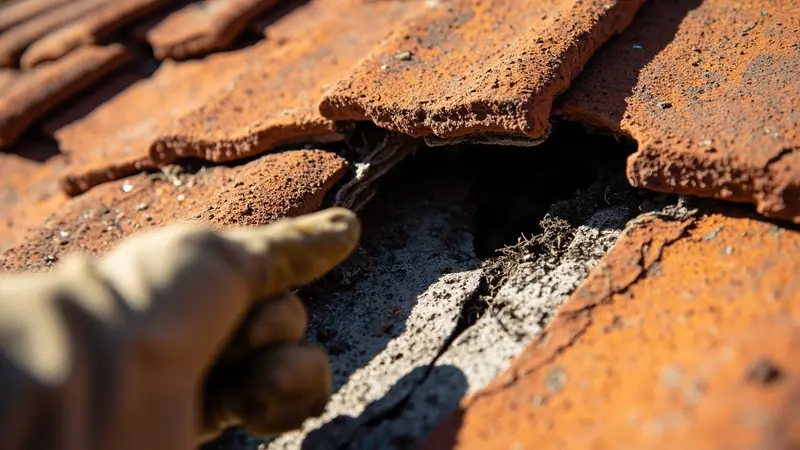
A handful of cracked ridge or hip tiles usually get lifted, cleaned out and reset in fresh mortar, and the work stays local to that run. A quick shingle patch over one lifted tab can hold through the next storm while a wider section gets scheduled for full attention. A split pipe boot or a bent piece of step flashing gets replaced rather than caulked, since sealant over metal works loose again with the next heat cycle.
Matching a repair to what's already on the roof matters too: a tile reset has to match the profile and color run above it, while a shingle patch pulls from the closest matching course. If the cracking runs the full ridge line, or several hips show the same hairline fractures, resetting one tile at a time stops making sense, and the whole run gets rebedded at once instead. Either way, each spot gets listed by name on the quote before any tile or shingle moves.
How the repair visit runs
On-site assessment
We start at the roofline from the ground, then move to the attic to check stain position and read the sheathing with the pin moisture meter. From there we check the pipe boots, valleys, and the ridge or hip run itself for cracked or missing pieces. You see each spot we flag, either pointed out from a safe angle or on the ground with a photo, and we explain what caused it. The visit ends with the cause named and the quote approved.
Repair and approval
After you approve the quote, we cover adjacent tiles or shingles near the work zone. This keeps loose debris from sliding further down the slope. A cracked ridge or hip tile gets lifted, old mortar cleaned out, and the piece reset in fresh mortar. A split pipe boot gets cut free and replaced rather than caulked over. If the attic reading showed wet decking, that section comes out and gets replaced before anything goes back over it. Nothing beyond the approved work starts without you seeing it first.
Final check
Before we leave, we read the sheathing again with the pin moisture meter at the repaired spot. A reading under 15 percent means the deck there is dry and the repair is holding. You'll see the reading beside the tile we reset or the pipe boot we replaced. We also highlight where we sealed the seams or mortar lines.
What roof repair needs in Ontario homes
Resetting ridge or hip tiles, or swapping a run of underlayment, usually falls within rules set by the California Residential Code, with the City of Ontario Building Department deciding what paperwork a given job needs. A simple reset of one or two tiles rarely triggers that review, but a full ridge rebed or a decking swap usually does, since opening the deck down to the boards changes what gets checked before it's closed back up.
Sealing a cracked ridge tile with roofing cement instead of resetting it in fresh mortar holds for one dry season. The cement dries and shrinks under the next summer's heat cycling, and the same crack opens again in the same spot.
Caulking over a cracked pipe boot instead of replacing it looks sealed from the ground, but the same heat cycling that breaks ridge mortar also breaks caulk loose from rubber and metal, and the leak starts again along the same path.
Covering a cracked valley or a chimney flashing joint with a tarp and leaving it past the next storm front just moves the water to a different seam, since a tarp edge lifts in the same wind that knocked the tile loose to begin with.
Patching a cracked tile with a mismatched profile or a different shingle batch keeps water out, but it sits higher or lower than the courses around it. That edge catches wind the same way the original crack did, and the patch itself becomes the next piece that comes loose. A reset that matches the existing run in profile and color holds through the next heat cycle instead. Houses with more valleys, dormers or chimneys lose more roof edge to this kind of movement than a plain gable does, since every joint is another place for mortar or sealant to crack loose first.
For storm resilience, the IBHS FORTIFIED standard is the playbook. Several of its upgrades cost little during a re-roof.
How the repair visit works for you
Today versus a booked visit
On the call we ask whether rain is coming through right now or the damage is only visible from outside. Active water inside usually brings a visit out the same day. If the tiles are down but the inside stays dry, the work can often wait for daylight and calmer wind, which makes resetting ridge and hip pieces safer. We also ask how long the damage has been there and whether anyone already tried to cover it.
What gets opened for access
Resetting ridge or hip tiles means time spent walking the roof peak and opening the mortar bed at each loose piece. Reaching a pipe boot or valley can mean lifting nearby tiles or shingles temporarily. Clear patio furniture, planters and vehicles from under the work area before we arrive. Inside, we may need attic access to check the sheathing from below, so clear a path to that hatch. Let us know ahead if pets are kept in the yard, since ladders and loose tile pieces will be going up and down near that space.
What decides the size
A roof with many valleys, dormers, chimneys or skylights takes longer to work around than an open run of plain ridge, because each penetration needs its own flashing check. A handful of loose tiles in one run stays a local reset. Cracking spread across several hips or a full ridge line moves the job toward a wider rebed. You see the quote in writing before we touch mortar or shingles, and you approve it before work starts.
What you see before we start
We show you the cracked or lifted tile, the pipe boot or the valley section before any mortar goes down, either in place on the roof edge or from the ground with photos. You hear the options for that spot and decide which one to approve. If a tile or boot comes out, we set it aside so you can see the piece that failed before it leaves the property.
Same Day Roof Repair Questions From Ontario Homeowners
Replacing an entire roof usually takes more than one day. Tear off, deck repair and new material installation each need separate time, and what decides the length is how many valleys, dormers, chimneys or skylights the roof has, since each one needs its own flashing work. A simple reset of a few ridge or hip tiles is a same-day repair, but swapping an entire roof covering spans several days. More roof edge from valleys and chimneys adds more time to that schedule.
Set a bucket under the drip and keep the area below it clear of furniture. A small hole opened at the low point of a ceiling bulge lets water drain in one place instead of spreading. Stay off the roof itself, since a cracked tile or torn shingle gives no footing once it has shifted. Call for a repair before the next wind event reaches the same opening.
A full roof replacement rarely finishes in one day. The time needed depends on roof size, how many penetrations like chimneys or skylights it has, and what the deck looks like once old material comes off. Tear off, checking the sheathing, and installing new tile or shingles each take separate time on site. A roof with several penetrations needs more flashing work than a plain gable. If wet or rotted decking turns up during tear off, that section has to be replaced before anything new goes down, which adds to the timeline.
A local repair, such as resetting a few ridge tiles, usually finishes in a day. What decides the length is how far the cracking or lifting runs and whether the attic check finds wet decking underneath it. If the pin moisture meter reads under 15 percent, the deck stays in place and the reset happens the same visit. A reading over 20 percent means that section needs to come out first, which adds time before the tile or shingle goes back down.
The time needed depends on whether the repair stays local or opens into a wider rebed or deck swap. A few loose ridge or hip tiles, or one split pipe boot, usually finish in a single visit. Cracking spread across several hips or a full ridge line takes longer, since the whole run gets rebedded instead of reset one tile at a time. Roofs with more valleys, dormers or chimneys add time too, since each penetration gets its own flashing check before work closes up.
Why ridge tiles crack loose fast in Ontario
Ontario sits under conditions that work against a mortar joint all year. Summer heat cycling expands and contracts clay and concrete tile daily, and the mortar holding ridge and hip pieces in place opens hairline cracks that widen with each pass. Add strong Santa Ana gusts, and a joint that was already thin gets knocked loose before the tile wears out. That changes the order of the work, since heat and wind affect the whole slope. A repair here checks every ridge and hip joint, not only the tile that already fell. On a roof with several valleys or chimneys, that same movement opens more joints at once than a plain gable sees. This is why the inspection runs the full ridge line before anyone reaches for mortar.
Work like a full ridge rebed or a swap of rotted decking gets a look at the framing before new tile goes back down, since what sits underneath has to pass before it's covered over. A simple reset of one or two tiles rarely reaches that threshold. That's why a cracked piece here gets checked against the sheathing with the pin moisture meter before anyone decides whether it's a reset or a deck repair, and why the written quote separates a local fix from a job that opens the roof down to the boards underneath.
Same Day Roof Repair Across Ontario and Nearby Towns
We handle Same-Day roof repair across Ontario and in these nearby towns.
Roofing Services Near Ontario
Looking for Same-Day roof repair near you in Ontario? Call (909) 330-4661 and we will confirm we cover your street.
Address:
Ontario Roofing, 4335 E Lowell St, Suite G
More Emergency Roofing Services in Ontario
Leave the ridge and hip tiles alone once one has cracked loose. Walking a broken tile line shifts the pieces around it and widens the crack in the mortar bed next to it, and footing on a pitched tile roof gives no grip once a piece is loose. That stretch of the roof belongs to the visit, where tying off and a mortar reset happen together.
Know when you noticed the tile or shingle down, and whether rain is actively coming through anywhere inside. If you can, note which side of the roof it's on and which direction the wind was blowing from, and whether a ceiling stain is spreading. Any sense of the roof's age or last repair helps too.