
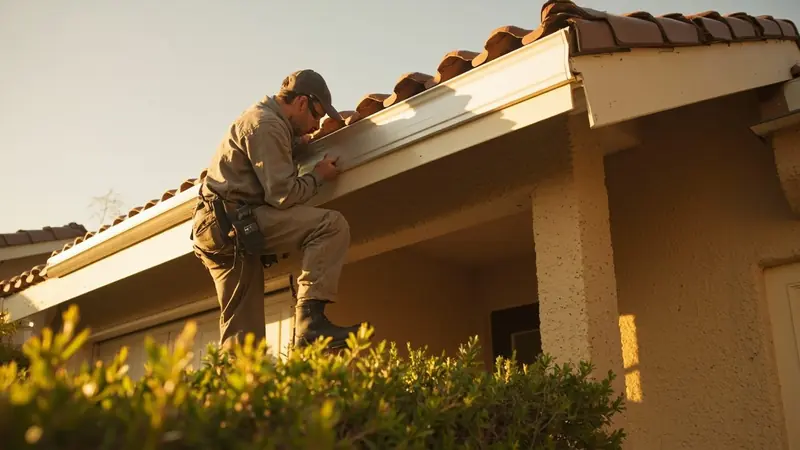
Gutter installation and repair for Ontario homes
Some houses in this city have never had a gutter, and some have had one for decades that no longer carries water where it should. Gutter installation and repair covers both jobs: hanging a new run on a house that has always shed water straight off the eave, and fixing or replacing a run that is already up but failing.
Older homes here were built to drop roof water directly onto the ground beside the wall. Newer tract sections instead carry it through gutters and downspouts out to the street. A house moving from one pattern to the other needs a full layout, not a patch, and that changes where downspouts land and how much pipe the job needs.
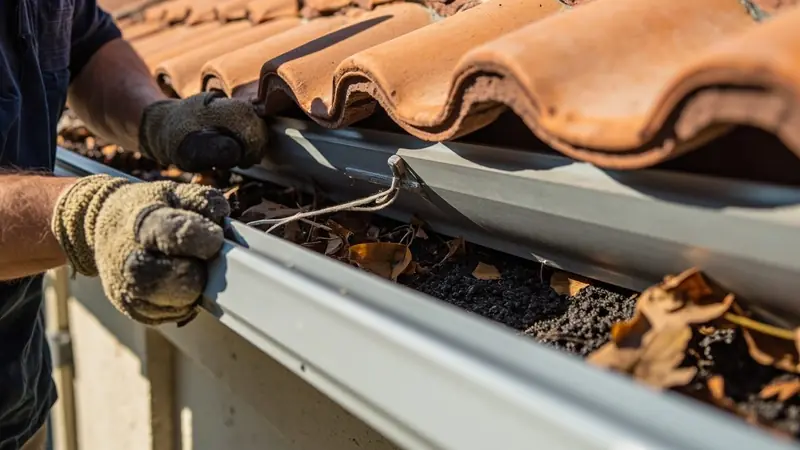
Once a gutter is up, the failure usually starts with debris. Leaves and grit sit in the trough and block the flow toward the downspout. Water backs up behind the front lip and runs over the back edge instead, soaking the fascia board behind it. Left alone, that board softens, and the first course of roofing above it loses the wood it needs to hold its nails.
If the fascia already flexes when you press on it, or paint is peeling in a line under the gutter, the wood behind the run is already wet. Call before the next rain adds to it, because a soft fascia board has to come out before a new or repaired gutter can be hung on it properly.
If the trouble turns out to need roof maintenance programs, that page explains how the job is done.
For storm resilience, the IBHS FORTIFIED standard is the playbook. Several of its upgrades cost little during a re-roof.
Find the sign you have, then read across to see how soon to call.
| Symptom or first sign | What is already happening | What it becomes if ignored | When to call |
|---|---|---|---|
| Gutters packed with debris | Water backs up behind the drip edge | The fascia and the bottom edge of the decking soften until the first course has nothing | Call this week |
| Blocked soffit intake | Attic humidity climbs and the nails sweat all winter | The sheathing delaminates and the shingles cup from underneath with nothing wrong on the surface | Call this week |
| A cracked pipe boot | Water runs down the vent pipe into the attic insulation | The ceiling below stains and the framing around the penetration softens | Call this week |
How a gutter installation and repair visit works
A gutter visit starts by finding out what is behind the gutter, not just what the gutter itself looks like.
- We walk the roofline and look at where water currently exits, pools, or drops straight onto soil.
- We press and walk the fascia board at a few points to feel for give.
- We check hanger spacing and pitch on any existing run, since a flat stretch is why water sits instead of draining.
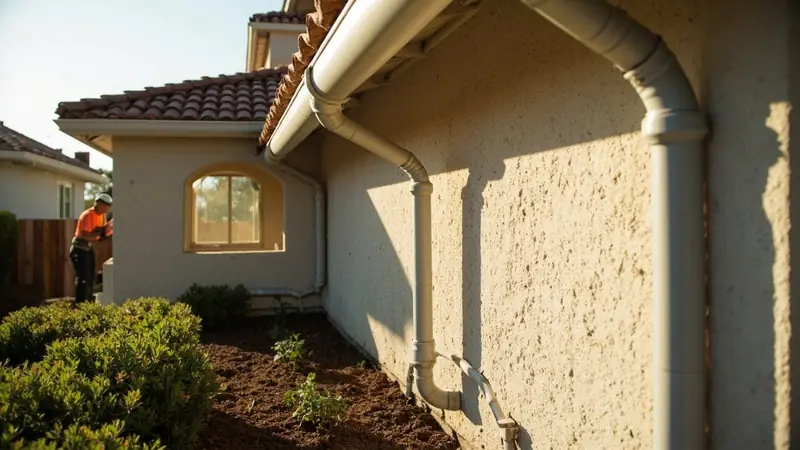
- We check downspout routing, since a pipe that dumps at the foundation instead of carrying water away is doing the opposite of its job.
- We write up what we found and what each option involves before any material goes up.
The walk test for deck deflection is what decides the repair. A board that stays firm underfoot can take new hangers and a resealed or replaced gutter. A board that gives or feels spongy means the fascia and the sheathing edge behind it come off before a new run goes up, because fastening a gutter to soft wood just repeats the failure.
From there the choice is between repair and replacement, and between gutter styles. A run with a few leaking gutter seams or a hanger pulling loose can often be resealed or refastened. Sagging gutters or gutters pulling away from roof along most of a run usually mean the whole stretch gets replaced rather than patched section by section.
On style, k-style gutters carry more water per run and fit most stucco tract homes built from the 1980s onward. Half round gutters suit older bungalows where the original trim detail calls for a rounded profile. Gutter installation is formed on site in one length, which cuts down on the seams that leak first. Gutter guards installation is worth discussing where trees shed heavily onto the roof, since it changes how often the run needs to be cleared by hand.
The CSLB License Lookup publishes the rules that govern work like this in your area.
How we handle your gutter job
Finding what the fascia is doing
We start at the roofline and look at where water is currently pooling, dripping, or missing a path altogether. We check hanger spacing, run pitch, and downspout routing, then press along the fascia to feel for soft spots. You see any area that gives underfoot pointed out directly. By the time we are done, we can tell you whether this is a reseal, a hanger fix, a full run replacement, or a fascia repair before any of that happens, and you have a written quote in hand before deciding.
Repairing or replacing the run
Once you approve the quote, we take down only the section that needs it, whether that is a few feet of seam or a full side of the house. A soft fascia board gets cut out and replaced before any new gutter goes on it, since fastening into damaged wood just repeats the failure. New or resealed sections are hung at a pitch that carries water to the downspout instead of letting it sit. You see the old material before it is hauled off.
Checking the run before we leave
Before we call the job done, we run water through the new or repaired section and watch where it exits. A run that is pitched right carries water straight to the downspout with no pooling along the trough. We show you the flow at the downspout outlet and point out the line where the fascia repair meets the original wood, so you can see the work that is now hidden behind the gutter.
What gutter work needs in Ontario homes
Adding a gutter where a house has never had one usually needs a permit. Ontario's Building Department inspects this work against the California Residential Code because it alters how the structure drains water. A straight repair or reseal of an existing run is more often routine, but the office decides which category a given job falls into.
On a bungalow where the board has sat untouched for decades, the screws hold for a season and then pull loose the first time the run fills with water. Another shortcut is routing a new downspout to match the old drop pattern of a house that never had one, which just moves the same soaking-the-foundation problem a few feet instead of carrying water out to where it can drain.
Pitch gets skipped too. A run hung level instead of sloped toward the downspout holds standing water after every storm instead of draining between them. On a tile roof house from the 1980s or 1990s, that standing water sits against the drip edge and works at the same underlayment that is already aging out on its own, so a badly pitched gutter speeds up a problem the roof already has.
Our page on damaged or clogged gutters covers the signs and the causes.
Our crews work to the installation standards of the National Roofing Contractors Association.
What the job looks like once you call
Same call, different paths
During the call we ask if water already reaches the fascia or siding, and for how long this has happened. A board that is visibly soft or a run actively dumping water against the wall usually points to someone coming out sooner. A slow overflow with no soaking yet can often wait for a scheduled visit. Either way we ask what you are seeing and when it started before we say which one fits.
What the work disturbs
Gutter work happens along the roofline and fascia, not inside the house, so nothing indoors needs to be cleared. Outside, we ask that planting beds, patio furniture, and anything parked close to the wall be moved back from the drip line before we start, since old gutter sections and fascia boards come down in pieces. A ladder or lift sits against the wall for the stretch being worked on, then moves down the line.
What sets job size
A repair at one bad seam or hanger is a smaller job than replacing a full run. One section with a soft fascia board is smaller than a whole side needing new wood underneath. Access matters too: a straight driveway that lets a material delivery or dump trailer park close to the house keeps the job simpler than a tight side yard where everything has to be carried in by hand. Once we see what the fascia looks like, you get a written quote to look over and approve before anything goes up.
What you see before we start
We point out any soft fascia or rotted decking at the eave before it comes down, so you see the wood we are talking about rather than taking our word for it. We walk through the gutter style and downspout layout options for that side of the house and ask which one you want before ordering material. If a board turns out worse once the old gutter is off, we show you that piece before it goes in the trailer.
Gutter Installation & Repair Questions From Ontario Homeowners
No single contractor holds an official number one ranking for gutter work in Ontario. Review scores and rankings change often and come from different sites, so they are not part of what decides a repair or installation. What matters more is what a visit finds: whether the fascia board is firm, whether hangers and pitch are set correctly, and whether the downspout routing carries water away from the foundation. Ask about those specifics when comparing options instead of relying on a star count or a ranking badge.
A gutter installer is the trade term for someone who hangs, seals, and repairs gutter systems along a roofline. The work covers forming or fitting gutter sections, setting hangers at the right spacing and pitch, connecting downspouts, and checking the fascia board behind the run for soft or rotted wood. On older Ontario homes this can also mean adding a full gutter system where one never existed, which changes downspout placement and how much pipe the job needs.
Tipping is not expected for gutter installation or repair work. If you want to recognize good work, a better use of that moment is asking questions about what was found, such as the fascia condition or how the new run is pitched, so you understand what is now hidden behind the gutter.
Hard water spotting itself does not weaken a gutter's metal or seams the way a clogged trough or a soft fascia board does. The marks you see are mineral deposits left behind as water evaporates. The larger concern is whether the spotting points to water sitting or overflowing in the same spot repeatedly, which can mean a pitch problem or a clogged section. That overflow pattern is worth having checked, more than the spotting on its own.
A downspout near the foundation concentrates water in one spot instead of spreading it to the street. Ontario sits on loose, sandy alluvial soil that drains fast but erodes easily under that kind of flow, so water dumped in one place cuts a channel into the ground and soaks the soil against the foundation over and over. Newer tract sections route that same water to the curb instead, which is why older homes built to shed water straight off the eave see this problem more.
Mineral spotting on stucco near a gutter means water ran down the wall instead of draining through the downspout. That pattern points to an overflow, a leaking seam, or a gutter pulling away from the roofline above that spot. The minerals are evaporated residue and do not damage the stucco itself, but the water path behind them can soften the fascia board over time if the same spot keeps getting wet after every rain.
Historic district homes follow the same code review as other Ontario homes when adding a new gutter system. A straight repair or reseal of an existing run is handled differently and often skips that review. The district itself carries no separate permitting authority for gutter work, so the Building Department makes the final call.
Wind loads on a gutter run work at the hangers and seams, since a long run acts like a sail and pulls at whatever is holding it to the fascia. Hangers that were already loose or spaced too far apart give first, letting that section sag or pull away from the roofline. A board that is already soft underneath gives the hanger nothing solid to grip, so wind finishes a failure that a weak fascia started. Checking hanger spacing after high wind is worth doing.
Why Ontario's soil and layout change gutter work
Ontario sits on alluvial soil washed down from the mountains, mostly loose sandy types that drain fast and erode easily under concentrated flow. A downspout that dumps water in one spot beside a house built on that kind of ground cuts a channel into the soil faster than it would on heavier clay. Storm water that does reach the street moves south through flood control channels such as the Cucamonga Creek channel. That is why newer tract sections are built to route roof water to the curb rather than let it sit against the foundation the way older houses were designed to shed it.
Adding a gutter system to a house that never had one requires review by the City of Ontario Building Department, since it changes how the structure sheds water onto the lot and affects the overall drainage on your property. Work that simply repairs or reseals an existing run is treated differently and often does not require that same level of review and approval from the Building Department. Because the review process examines where new downspouts will discharge water and how that affects drainage on your property, we plan that routing carefully before any material is ordered and before work starts, not after the gutter is already up.
Gutter Installation Across Ontario and Nearby Towns
We handle gutter installation across Ontario and in these nearby towns.
Roofing Services Near Ontario
Need gutter installation in Ontario? We cover the city and the nearby towns on the map. Call (909) 330-4661 to check your address.
Address:
Ontario Roofing, 4335 E Lowell St, Suite G
More Residential Roofing Services in Ontario
Clearing leaves and grit out of a gutter by hand from a ladder on level ground is reasonable for a homeowner to do. Stop there. Pressing on the fascia or pulling a gutter section to check for rot means working at the roofline, and a board that lets go under your weight is how falls happen. Checking the fascia, replacing it, and hanging new or repaired gutter sections belong to the visit.
Know roughly how old the roof and gutters are, and where you are seeing the problem, overflow at a corner, water at the foundation, or a section pulling away from the fascia. If you can, note whether it happens during every rain or only heavy ones, and whether any downspout empties close to the house.