
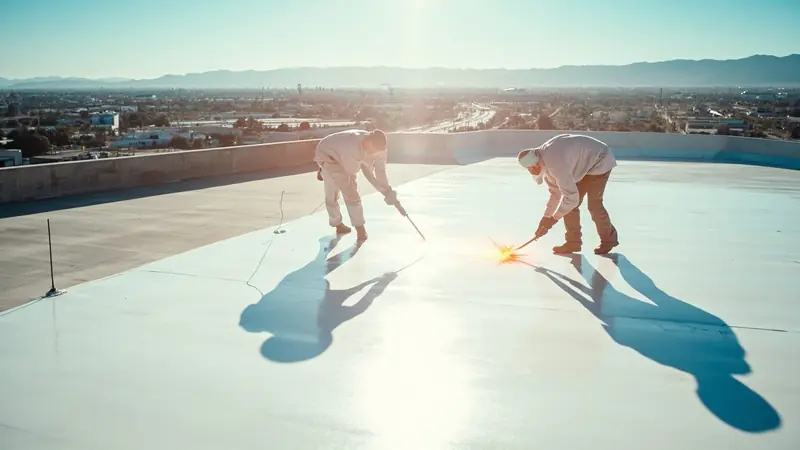
What is PVC roofing installation?
A flat roof that handles kitchen grease, chemical exhaust or standing water needs a membrane built to resist all three. That is what PVC roofing installation does. It lays one sheet of PVC roofing membrane across the deck, with every seam welded into a single surface instead of taped or glued. Restaurant exhaust hoods, chemical fume stacks and loading docks with a ponding history are the roofs that call for it, since oil and solvent contact break down asphalt and EPDM faster than PVC. A roof without grease or chemical exposure often does fine with EPDM flat roofing instead.
Older membranes on these roofs show their own signs. PVC membrane shrinking pulls at fastener plates and corners first, and PVC roof seams separating follow once that tension exceeds what the weld can hold. Those are reasons to plan a new PVC roof installation rather than another round of patching, since each patch next to a tightening membrane fails the same way the last one did.
Summer heat here climbs into the mid 90s by August, and that daily swing stresses every seam on a low slope roof. Add the gusty, dry winds that blow through the valley each fall, and loose edge flashing lifts before the heaviest rain of the year arrives. That rain, concentrated across a few winter months, is what tests a roof for ponding.
A pinhole at a seam is usually where a PVC roofing membrane fails first, often where a seam already weakened by age or old welding meets standing water. Once water enters that gap, it travels horizontally across the insulation beneath the membrane instead of falling straight down. A board that stays wet loses its insulating value, and the deck under it corrodes well past the point where the pinhole sits.
For a commercial building, that corrosion can affect load capacity over the area it reaches, which turns a repair question into a liability one. A soft spot, a dark ring on the ceiling below, or standing water that has not drained within two days of a storm are signs the deck underneath is already compromised. That combination is worth a call now, before a small welding repair turns into an opened section of deck.
Our crews work to the installation standards of the National Roofing Contractors Association.
What happens during a PVC roof installation visit
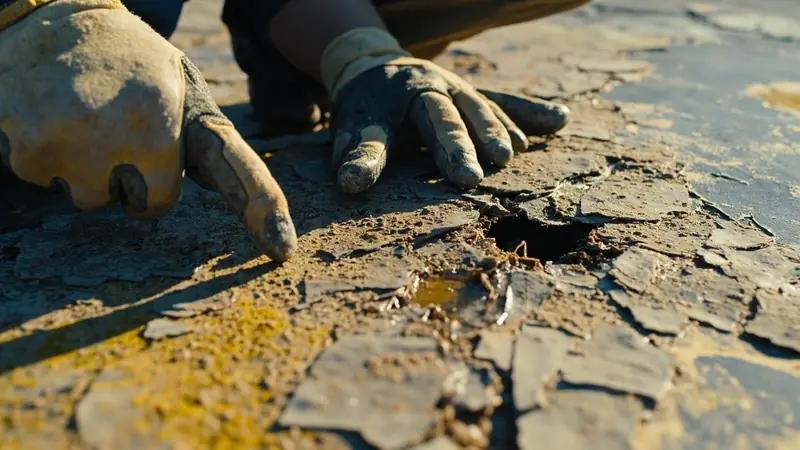
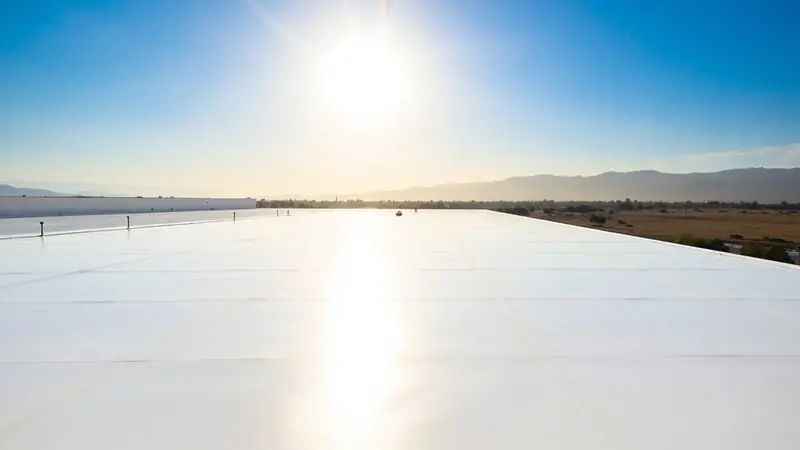
A PVC roof installation visit starts with a core sample, then moves through tear off, deck repair and welding the new sheet into place.
- We cut a small core sample to check moisture in the existing insulation and deck.
- We clear the roof surface down to sound deck or an approved recover base.
- Any soft or wet decking gets cut out and replaced before anything else goes down.
- New insulation board goes down and gets fastened or adhered to the deck.
- The PVC sheet rolls out and each seam is welded with hot air equipment.
- Flashings, drains and curb terminations are welded last and checked for a tight seal.
The deciding finding comes from that core sample. A core that comes out dry through every layer means the insulation and deck under the old roof can stay, and the new membrane goes down over a recover board. A core that comes out saturated means that section of deck is compromised, and it gets opened down to sound wood before anything goes back down.
Some buildings are a better match for TPO single ply membrane instead. Mechanically attached TPO suits a roof with a sound deck and no ponding history, while fully adhered TPO handles higher wind uplift requirements. TPO's heat-welded roof seams and white reflective surface cut cooling load through Ontario's summer heat. PVC stays the better call over grease, chemical exhaust or seams that sit under standing water, since its chemistry resists oil and solvent contact that wears on TPO over time. Among PVC roofing contractors, that exposure test is usually what settles the choice.
Thickness is the other variable inside a PVC roofing system. A lighter sheet works where foot traffic stays occasional, and a heavier, puncture resistant sheet earns its place near rooftop equipment, ladders or recurring maintenance walks. That choice, made before welding starts, is part of the written quote you approve.
The CSLB License Lookup publishes the rules that govern work like this in your area.
Steps in a PVC roof installation
On site assessment
We open the roof with the core sample, checking moisture at the point most likely to be wet. You see the cut and what comes out of it before we talk about work. That walk also tells us whether this is a repair, a recover or a full tear off, which sets the shape of the written quote handed to you before any further work begins.
Approval and the work
Once you approve the job, we isolate the affected section first, clearing it to sound deck or an approved recover base. The new sheet goes down next, rolled and welded seam to seam, with flashings and curb terminations welded last. Work pauses again at that point so you can see the finished seams and terminations before we close out the project.
Final check
We walk the finished roof and confirm the deck feels firm underfoot, with no give between structural members, under the new membrane. That walk happens before anything is signed off. We show you the welded seam pattern at drains and curbs, the points most likely to be tested by standing water first.
What this job needs on an Ontario building
A new PVC roof installation usually needs a permit, and plans go through the City of Ontario Building Department before the tear off starts. That review treats the membrane, insulation and deck as one assembly rather than inspecting the covering by itself. Commercial alterations above a certain job trigger that same review even when only the membrane changes and the deck stays in place.
A membrane welded over wet insulation seals that moisture under a surface with no way out. The deck below keeps corroding where nobody can see it until a ceiling stain shows up a season or two after the roof was finished.
Reusing old flashing at drains and curb penetrations is another one. A seam separating at a reused termination bar is a common point of failure, since the old metal was shaped and sealed for a different membrane thickness than the one going down now.
Flat sections added onto 1980s and 1990s stucco buildings here often sit over additions with shallow slope and limited drainage. A membrane installed without correcting that slope keeps ponding in the same low spot every winter, no matter how new the material is.
Not every flat roof needs a full PVC system. TPO roofing suits a building without grease, chemical exhaust or ponding history, and it carries less material mass per square than a PVC build-up with recover board. A membrane that still seals but has lost its reflective surface is often a candidate for roof coatings and restoration rather than a tear off.
How a PVC roof project runs on your building
Scheduling the first visit
On the call we ask how the current roof is failing, whether it is an active leak into occupied space, and whether the building limits welding noise or odor to certain hours. An active leak into occupied space usually moves the visit up. A planned replacement with no active leak gets scheduled around your calendar and whatever rooftop equipment access needs to be cleared first.
What the project disturbs
Rooftop access through a hatch or ladder gets used throughout the job. Any rooftop units or exhaust fans in the work area get braced or temporarily moved to reach the deck under them. Material staging needs a cleared area below for a hoist, and tenants below the work area should expect welding noise during the hours we are on the roof. Clear that staging area and tell occupants before the date is set.
Membrane class and job size
The membrane class you choose, a standard PVC sheet or a thicker, puncture resistant one, is the largest factor in how this job scales. Whether the deck under the old roof needs repair once it is exposed is the other one, and that is not known until the core sample and tear off are underway. You see a written quote before anything more comes off the roof, and you approve it before that work starts.
What you see and approve
We show you the core sample on site, point out any wet insulation or soft decking it turns up, and set the old membrane section next to it so you can see the failure. You decide between a repair, a recover or a full PVC roof installation before we go further. Nothing past that point gets opened without your go ahead.
PVC Roofing Installation Questions From Ontario Businesses
Installation begins with a core sample to check the deck for moisture. Crews clear the roof to sound deck or an approved recover base, then set new insulation board and fasten or adhere it in place. Any wet or soft decking found during tear off is cut out and replaced before the new membrane goes down.
A PVC roofing membrane is a single welded sheet covering a flat roof deck. Every seam is heat welded into one continuous surface instead of taped or glued, which resists oil, solvent and standing water contact. Thickness varies by how much foot traffic or rooftop equipment the roof carries.
PVC roofing membranes shrink with age and pull at fastener plates and corners first. That tension eventually separates a welded seam, usually where age or old welding already weakened it. Choosing too light a sheet is another downside, since it punctures where rooftop equipment, ladders or maintenance walks cross it. A membrane welded over wet insulation traps that moisture under the surface, letting the deck corrode out of sight until a ceiling stain appears. Matching sheet thickness to the traffic pattern lowers that risk.
PVC holds up better than EPDM wherever grease, chemical exhaust or standing water touches the membrane. That resistance comes from PVC's chemistry, which stands up to oil and solvent contact that wears down EPDM faster. A roof without that kind of exposure, like one without a kitchen hood or fume stack nearby, often does fine with EPDM instead. The choice comes down to what sits above and around the roof.
Installation follows the core sample result, which shows whether the deck stays or gets opened. A saturated core means that section gets cut out and replaced with sound wood before anything else. Once the deck is ready, insulation board is fastened or adhered, and the PVC sheet rolls out with every seam welded by hot air equipment. Flashings, drains and curb terminations get welded in the final pass, since those points take the first hit from standing water.
Insulation board sits directly under a PVC roofing membrane, fastened or adhered to the deck below it. That board rests on the deck itself, which is checked with a core sample before anything new goes down. A dry deck gets a recover board over the old roof, while a saturated or soft section is cut out and replaced with sound wood first. Thickness of the insulation and the deck condition together decide how much work happens before the membrane is rolled out and welded.
Why Ontario's heat changes PVC roof installation
PVC membranes resist heat cycling and UV exposure, keeping seams stable through Ontario's hot, dry summers. This makes PVC roofing a durable, low-maintenance choice for flat and low-slope roofs. The stress on a flat roof here comes from the air instead. Daily swings between a hot afternoon and a cooler night work at every one of the membrane seams, which is one reason those seams get welded rather than taped or glued. Summer heat here runs hotter and drier than many membranes were built for, and that heat softens adhesive based systems faster than a welded PVC roofing membrane. The same core sample that decides repair from replacement also shows how that heat and daily cycling have treated the insulation underneath, since a board that has absorbed moisture loses its ability to buffer that swing and the deck under it keeps corroding.
Roofing assemblies on a commercial building here fall under the California Residential Code, which treats the insulation and the membrane as one system rather than inspecting the covering on its own. That is why a permit review looks past the surface sheet to the board underneath it. Low spots that pond for more than a day or two after a storm get asked about directly, since drainage is part of the same review. That review usually happens before the deck is covered, not after, which is why the core sample findings get documented as part of the job.
PVC Roofing Installation Across Ontario and Nearby Towns
Our Ontario crew also covers these towns for PVC roofing installation.
Roofing Services Near Ontario
Need PVC roofing installation in Ontario? We cover the city and the nearby towns on the map. Call (909) 330-4661 to check your address.
Address:
Ontario Roofing, 4335 E Lowell St, Suite G
More Commercial Roofing Services in Ontario
- Commercial Roof Repair
- Commercial Roof Replacement
- Flat Roof Repair
- Commercial Roofing Contractors
- TPO Roofing Systems
- EPDM Flat Roofing
- Modified Bitumen Roofing
- Built-Up Roofing Systems
- Roof Coatings & Restoration
- Commercial Metal Roofing
- Commercial Roof Maintenance Plans
- Commercial Roof Inspections
- Industrial Roofing Services
- Multi-Family & Apartment Roofing
- All commercial roofing services
- Wind Damage Roof Repair
- Storm Damage Roof Repair
- Emergency Roof Repair
A ceiling stain or a bubble in ceiling tile inside the building below a flat section is something you can spot without going on the roof. It tells you roughly where water is sitting above, not how far it has traveled under the membrane or whether the deck underneath is still sound. Pinpointing that source, cutting the core sample and opening the roof to check the deck belongs to the visit.
Know when the stain or ponding was first noticed and what changed right before it, such as new rooftop equipment or a recent storm. Have the roof's approximate age and membrane type if you know them, along with where the roof hatch or ladder access is. Tell us whether the space below is occupied during the day.