
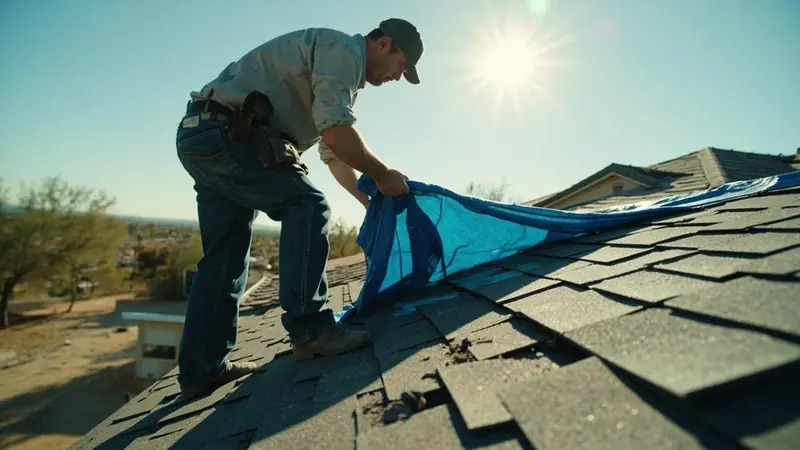
What an active leak during a storm means right now
An active leak during a storm means water has already found a path through the roof covering and underlayment. It is moving along the underside of the decking before it drops into the house. That is the moment emergency roof repair starts, and the first job is finding where water is entering, not just where it is dripping out.
If you are standing in the house right now, get everyone out from under a sagging or dripping ceiling and keep them out of that room. If water is running anywhere near a ceiling light, a fan or a smoke detector, shut that circuit off at the panel before anyone touches the fixture. Put a bucket under the drip, and if the ceiling is bulging, open one small hole at the low point so the water has a single place to come out.
A ring from water coming through ceiling plaster usually sits downhill from the real opening, because water runs along a rafter or the sheathing before it drops. A roof leaking during storm conditions is often wind driven, so a leak that stops when the wind shifts points at a wall intersection or a valley rather than the open field of the roof.
A hole in roof from tree limb contact during a wind event is easy to place, since the damage usually sits right where the limb came down. Granules collecting at a downspout outlet after a storm point at damaged asphalt mat, even on a slope that still looks intact from the ground.
Ontario sees wind events strong enough to lift roofing material, and the wettest stretch of the year is also when a small opening turns into an active leak fast. Here, roof damage after wind storm events often starts the same way: a lifted shingle tab lets wind get under the course above it, then on the next storm a full strip of shingles peels off and bare decking takes the rain directly. Once decking is exposed, every hour of rain adds weight and softens the wood further.
Call now if the stain on your ceiling is growing between checks, if water is dripping rather than just staining, or if you can see daylight or sky through the roof deck from inside the attic. An opened section like that calls for emergency roof tarping to stop water entry until the covering can be replaced.


Can you patch a roof instead of replacing it?
Patching is possible when the decking under the damaged area is still sound, and a pin moisture meter is what decides that call. Inside the attic, we read the meter against the underside of the sheathing near the leak: a reading under 15 percent means that wood is dry enough to work with, and a reading above 20 percent means that section is already compromised and has to come out.
We start inside. A flashlight check finds the stain path, nail staining and any daylight at a penetration, and that tells us roughly where to go on the outside. A directional leak that only shows up when wind comes from one side usually sits at a wall or a valley.
If the deck reads dry and the shingles around the opening still flex without cracking, the fix is a patch: replacing the damaged course, boot or flashing section and tying the new material into what is sound. If the deck is spongy underfoot or the shingles shed granules when lifted, that section of roof has to come off down to new decking. A patch over wet or rotted wood fails again on the next storm.
A wind damage roof event changes the calculus too. A single lifted strip from one storm usually patches. A field of lifted tabs across several courses, the kind straight-line gusts leave behind, usually means the whole slope is past patching, and a storm damage roof patch on just the worst spots will not hold through the next event.
A roof leaking right now on a building other than a house gets planned the same way, just faster. An emergency commercial roof check on a low slope section looks for ponding and seam separation rather than shingle flex. Same-day roof work on a residential slope usually closes the opening the same visit, with the full repair or replacement scheduled once the deck condition and the material needed are confirmed.
After severe weather, FEMA's guidance on documentation makes the difference in how smoothly a claim goes.
Before any part gets replaced, ask to see each of these readings.
| Instrument | Good reading | Bad reading | What it changes |
|---|---|---|---|
| Intake versus exhaust ventilation balance | Intake net free area at the soffit at least equals the exhaust net free area | More exhaust than intake | Makes the ridge pull conditioned air out of the house and moisture into the deck |
| Ponding check on a low slope roof | The surface is dry and the drains are clear within about two days of rain | Standing water still sitting two days after rain | Loads the deck and works at every seam |
| Shingle flexibility and granule check | A tab lifts slightly at the corner and the granules stay put | The tab cracks when it is lifted and granules come off in your hand | The asphalt has aged out |
| Infrared scan of a low slope roof after sunset | The field cools evenly as the sun goes off it | Warm patches that hold heat after dark | Wet insulation stores heat that dry insulation has already given up |
| Core cut sample on a low slope roof | The insulation core comes out dry through every layer and the deck under it is sound | A saturated or crushed core | The wet area is larger than the visible stain |
Steps we take on an emergency call
Finding the entry point
We start at the stain or drip, then work back along the rafters to the roof side, checking nail lines, flashing and the sheathing moisture reading as we go. You will see us in the attic first, tracing the stain path with a light before anyone goes onto the roof itself. Once we find the opening, you see the reading that tells us whether the decking underneath is dry or compromised, and we walk you through what that means for a patch versus a larger section of roofing. By the end of this part of the visit, you have a written quote in hand for the fix we are recommending.
Sealing the opening
Once you approve the quote, we isolate the wet area first, pulling back the damaged covering and any soaked insulation or decking underneath before anything new goes on. The repair itself follows the finding from the assessment: a new section of shingles or membrane tied into sound material on every side, new flashing or a boot where that was the source, and the deck replaced underneath if the reading called for it. We pause before closing anything back up so you can see the open section and the new material going in, rather than finding out only once it is covered again.
Checking the fix
Before we leave, we read the pin moisture meter against the decking at the repaired section, and it has to come back under 15 percent to call that area dry. We also check the surrounding courses or seams for any sign the same wind or water path reached a second spot nearby. You get to see that reading, the replaced material, and removed decking, confirming real changes instead of trusting our word. That number is the same one that decided whether this stayed a patch or became a larger repair earlier in the visit.
What emergency roof work still has to meet here
A temporary tarp or patch to stop water is not the same thing the City of Ontario Building Department reviews under the California Residential Code. Covering an active opening to protect the house usually does not need a permit, but putting new roofing back on usually does, and whether it is treated as a repair or a full reroof is the department's call once decking condition is known.
A shortcut that causes trouble here is sealing a lifted tab or a split boot with roofing cement alone and leaving it. Cement skinned over the top looks fixed from the ground, but it does not restore the nailing or the lap that kept wind from getting under the course in the first place, and the same spot lifts again on the next event strong enough to catch an edge.
Another shortcut: covering a wet area with a tarp and never checking what is under it once the rain stops. Wood holds water for days after a storm passes, and a tarp left in place traps that moisture against the decking instead of letting it dry. By the time the tarp comes off for the real repair, a section that could have been patched has gone soft.
On a low slope section, patching one visible seam without checking the rest of the field misses the point. Membrane punctures and opened seams tend to cluster where foot traffic crosses or where a unit sits on a curb, so a single patch job that skips those spots gets called back out after the next rain.
Even urgent roof repair work still has to close out the same way a scheduled job does: the opening sealed, the deck checked, and the fix tied into sound material on every side, not just patched where it is visible from a ladder.
Our crews work to the installation standards of the National Roofing Contractors Association.
What happens once you call
Someone today or a booked visit
On the call, we ask what you are seeing, whether water is actively dripping or just staining, and how long it has been coming through. Active dripping, a growing stain or daylight visible in the attic from the roof side point toward someone going out the same day. A stain that has stopped growing and shows no active drip can usually wait for a scheduled visit. Either way we ask about access to the attic and the roof itself before we talk about the schedule, since an opening on a steep slope changes how fast someone needs to get up there.
What the visit disturbs
Stopping an active leak usually means getting onto the roof over the wet area, and sometimes opening the ceiling below it from underneath to see how far water has traveled. Clear the room under the stain of furniture and electronics before we arrive, and move anything stored in the attic away from the leak path. Accessing some roof sections means stepping through planting beds or over a fence line below the eave, so clear a path to the wall if you can.
Size of the fix
The biggest question is what the decking looks like once the wet covering comes off, and nobody can tell that from the ground or even from inside the attic. A dry deck under a damaged section usually means a patch at that one spot. A soft or delaminated deck means that section comes out and gets replaced before new roofing goes back on. How many courses or how much of the field is affected also decides whether this stays a patch or becomes a larger repair. You see the finding and approve the quote before any of it starts.
What you see before work starts
We show you the wet decking or the failed flashing where it is found, not just a description of it. You see the moisture reading, where the water has traveled compared to where it is dripping, and the options for closing it up. Nothing on the roof or inside a wall gets opened further without you agreeing to it first. If a section of decking has to come out, you see it before it goes in the trailer, not just a line on paper.
Emergency Roof Repair Questions From Ontario Homeowners
Patching starts with finding where water enters, not just where it drips, usually traced from inside the attic along the rafters and sheathing. A pin moisture meter read against the underside of the decking tells whether that section is dry enough to patch or has to come out. A tarp placed over an opening only stops water short term, and walking the roof or sealing flashing is work for someone tied off. Clear the room below the stain and the attic path near the leak before the visit so the area can be checked and sealed.
Active dripping, a growing stain, or daylight seen in the attic means the leak needs attention the same day. Either way, decking that stays wet for days softens and holds water, so the longer an opening sits uncovered, the more likely a patch turns into a section that has to be replaced down to the sheathing. Describe what you're seeing and when it started so the right timing gets decided.
The pin moisture meter reading on the decking decides whether a repair stays small or grows. What changes the size of the job is whether the decking under the damaged area is still dry or has already taken on water, checked from the attic side near the leak. You see that reading and the options for closing the opening before any work starts, so you know what the quote covers and why, based on what the decking tells us rather than a guess from the ground.
A handyman can tarp a small opening to slow water entry. Sealing a lifted shingle or split boot with roofing cement alone only looks fixed from the ground. Finding the real entry point, reading deck moisture from the attic side, and tying new material into sound roofing on every side is work that belongs to a full roof visit.
The moisture reading on the decking decides how large a repair needs to be. You see that finding, and the quote built from it, before anything is opened further or any material comes off the roof, so the size of the job is set by what's found.
How Ontario's wind and rain load change emergency roof repair
Ontario's older housing, from the 1945 to 1970s tract era, carries low pitch gable roofs over shallow attics that are hard to vent well, and those roofs are into the stretch of their life where the covering itself is simply worn out. Homes from the 1980s and 1990s carry tile roofs where the underlayment under the tile, not the tile itself, is reaching the end of its service life, so a leak can show up with every tile on the roof still intact and unbroken. San Bernardino County's wind events move fast across this part of the Inland Empire. A low pitch roof with a worn covering catches that uplift at the edges and ridge before a newer roof would. Heat through the summer months adds thermal cycling that works at every seam and fastener on both roof types before the next wind event arrives.
Inspection on a reroof happens after the old covering is off and before new material goes down, so the inspector can see the decking before it is covered again. That is the point where a soft or delaminated section gets caught if it was not already found during the emergency visit. On a patch to stop an active leak, no new inspection stage usually applies, since no decking changed and no load path changed. A patch that later gets folded into a full reroof picks up that inspection step at that point. The difference matters for timing: a full-slope repair plans around that open-deck inspection window, while a tarp and patch does not wait on it at all.
Emergency Roof Repair Across Ontario and Nearby Towns
We handle emergency roof repair across Ontario and in these nearby towns.
Roofing Services Near Ontario
Need emergency roof repair in Ontario? We cover the city and the nearby towns on the map. Call (909) 330-4661 to check your address.
Address:
Ontario Roofing, 4335 E Lowell St, Suite G
More Emergency Roofing Services in Ontario
From the ground, you can zoom in with a phone camera or binoculars to check for a lifted strip, a dark patch where granules are gone, or a branch resting on the slope. That look tells you where to point us, but it stops there. Walking the roof, lifting shingles, and sealing flashing belong to the visit, since a wet or storm-damaged surface is not something to be on without fall protection.
Before you call, know when the leak started and whether it is dripping or just staining. Note which room and which side of the roof it is under, and whether anything changed right before it, such as new wind or a tree limb coming down. If you know the roof's age or material, have that ready too, along with whether anyone is in the house right now.