
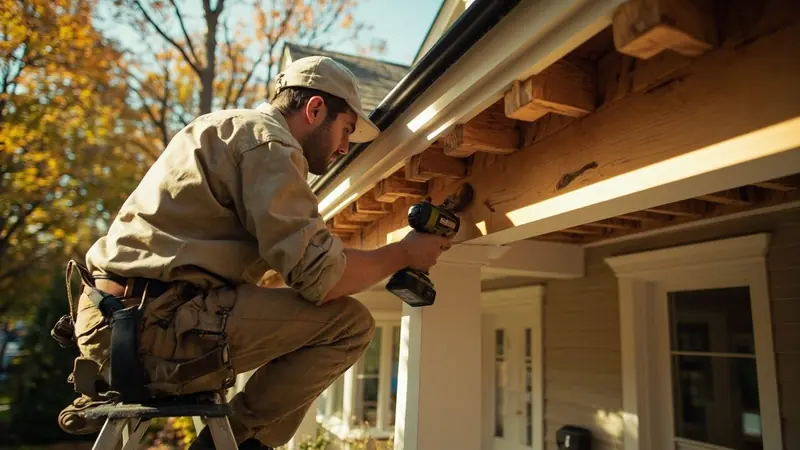
Repair or replace soffit and fascia?
Soffit and fascia repair patches or replaces the wood that closes off the roof edge. The fascia board carries the gutter, and the soffit panel closes the underside of the eave where one exists. A section with peeling paint on fascia gets scraped back, primed and repainted. A rotted fascia board or a soffit falling off at the nail line gets cut back to sound wood. It gets replaced there.
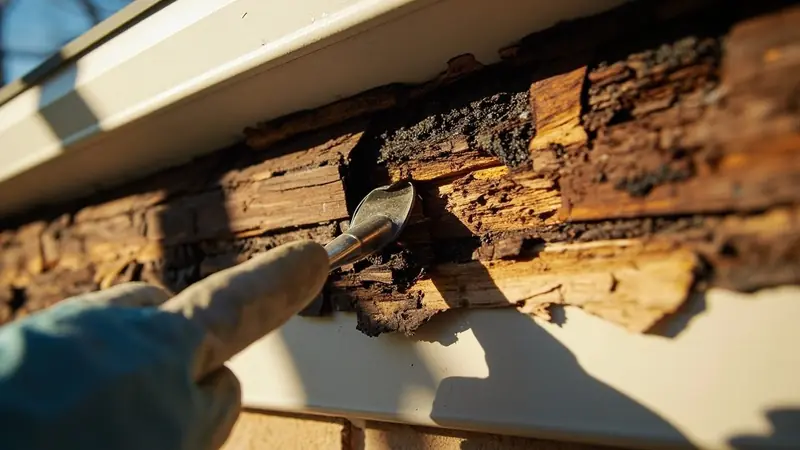
On many Ontario eaves the trouble starts in the gutter. Gutters packed with debris hold water against the drip edge instead of letting it run clear. That water sits against the fascia board until the wood starts fascia board rotting from the back side, where you cannot see it. Santa Ana wind events in fall and winter work at an already loose board, prying at nails that no longer bite solid wood. Once the board stays wet long enough, the decking edge above it softens too, and the first course of roofing loses the wood that holds its nails.
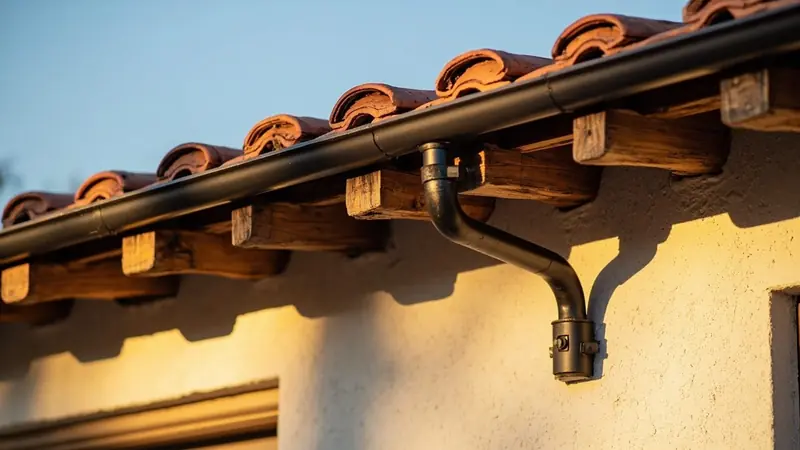
Houses from the 1900s through the 1930s Model Colony era often have open rafter tails instead of a boxed soffit. Craftsman bungalows and Spanish revival homes from that period show the rafter ends and the fascia board in the open, with no panel to hide rot behind. On one of these houses, soffit repair means a rafter tail and fascia board repair job, since the end grain takes water straight on.
A fascia board that flexes under thumb pressure, or a gap between fascia and gutter that keeps opening, means the wood underneath is already wet. Left through a winter storm season, that soft wood stops holding nails, and the gutter can pull away from the house with the next heavy rain. That sequence runs faster on an open eave, since there is no soffit panel buffering the rafter tail from direct rain. Call once you can press a thumbnail into the board or watch the gutter sag away from the eave.
The CSLB License Lookup publishes the rules that govern work like this in your area.
Find the sign you have, then read across to see how soon to call.
| Symptom or first sign | What is already happening | What it becomes if ignored | When to call |
|---|---|---|---|
| Gutters packed with debris | Water backs up behind the drip edge | The fascia and the bottom edge of the decking soften until the first course has nothing | Call this week |
| A cracked pipe boot | Water runs down the vent pipe into the attic insulation | The ceiling below stains and the framing around the penetration softens | Call this week |
| Missing kickout flashing where a roof meets a wall | Water runs behind the siding instead of onto the shingles | The wall sheathing rots with no stain on the roof at all | Call this week |
How the soffit and fascia repair visit works
We start inside the eave, not up on the roof field, since a soft fascia board usually traces back to the gutter and the decking just above it.
- We walk the gutter line and check for debris holding water against the drip edge.
- We press and probe the fascia board at the gutter line and at each rafter tail.
- We check the soffit panel, or the open rafter tails on an older eave, for soft wood and daylight gaps.
- We run the walk test for deck deflection along that stretch, feeling for a spongy or springy deck between rafters.
- We write up what is sound, what is soft, and the quote, before any wood comes off the house.
Each probe point gets marked, so by the end of the walk we have a map of where the wood is sound and where it gives. A rafter tail that feels solid two feet from a soft spot usually marks where the repair can stop, rather than running the fix the full length of the eave.
A deck that feels firm under that walk test, with no give between rafters, means the fascia and soffit repair stays at the edge of the roof. A deck that gives, or feels springy underfoot along that stretch, means the repair reaches up into the decking itself, not only the trim below it, and the quote reflects that before any wood comes off.
On an open eave bungalow, fascia board repair matches the exposed rafter tails that are already there, since there is no soffit panel to switch to instead. On a boxed eave, aluminum soffit replacement and vented soffit panels hold up with less repainting than a wood fascia board, and that often comes with roof ventilation work where the soffit intake needs to be reopened so the attic can breathe. Where the gutter itself has already pulled nails loose, we note that separately, since a sagging section often needs new fasteners or a short run replaced before it can carry water away from the new board at all.
Seeing a related sign? Read about cracked or damaged flashing.
Steps for your fascia repair visit
Checking the eave on site
We start at the gutter line and work along the eave on foot, pressing the fascia board at each rafter tail and watching the gutter for sag. Where the eave is boxed, we check the soffit panel for soft spots and daylight gaps at the seams, and we run the walk test for deck deflection above the suspect section. You see which spots probe soft and which hold firm, section by section, as we go. Once we know how far the rot runs, we write the finding and the quote on site, before anything comes off the house.
Replacing the damaged section
Once you approve the quote, we pull the gutter section along the repair run first, since it has to come off before the fascia board underneath is reachable. Sound wood stays, and the rotted fascia board or soffit panel gets cut back to the nearest solid rafter tail rather than patched over a soft edge. New wood goes in at that same line, sealed at the end grain, and the gutter goes back on once the board under it is solid.
Checking the finished edge
Before we leave, we run the pin moisture meter against the new fascia board and the decking edge above it. Moisture below 15 percent counts as dry wood, and the new board needs that reading before you apply paint. We show you that reading, point out where the old gutter line used to trap water, and leave the drip edge flashing lapped over the gutter the way it should sit.
What soffit and fascia repair needs in Ontario homes
Soffit and fascia repair that stays at trim level, matching an existing profile, usually does not need a permit. Projects that open the roof edge, replace decking, or change rafter tails usually need this step. The City of Ontario Building Department signs off before the job is finished.
Skipping ahead on this job tends to show up fast in a valley that gets most of its rain in a short winter stretch. Painting over a soft fascia board without cutting back to sound wood looks fine through one dry summer, then the paint film cracks again as the wood keeps moving under it.
Nailing a new soffit panel against a fascia board that is already rotten holds for a while, then the fasteners pull free the first time wind gets under the panel edge. That shows up fastest on an open eave bungalow, where there is no boxed cavity to slow the wind down.
Matching an old wood profile with a stock aluminum trim piece is another shortcut that looks right from the ground. The reveal and the drip edge flashing line up differently than the original, so water finds a new gap at the first seam instead of running clear past it.
Running a new gutter section without clearing what packed the old one brings the same debris back within a season. The fascia starts softening again from the same spot it did before. Swapping a vented panel for a solid one to save a step closes off the air path the attic depends on, which shows up later as moisture with nothing wrong on the roof surface above it. A chimney flashing repair belongs on a separate call when water tracks down the chimney wall instead of the gutter line, since that path into the attic has nothing to do with the eave.
For storm resilience, the IBHS FORTIFIED standard is the playbook. Several of its upgrades cost little during a re-roof.
What to expect from the repair visit
Same day or scheduled repair
On the phone we ask whether the fascia board or gutter is actively pulling away from the house, and how high up that section sits. A board that has already pulled loose with the gutter still hanging from it often gets someone out the same day. A faded or peeling fascia board with no movement yet usually gets set on the calendar within the week, since that wood is still holding. Either way, we confirm what you are seeing before the visit gets scheduled.
What the work disturbs
Soffit and fascia repair opens the eave along the roof edge for the length of the visit. Clear patio furniture, planters, grills and parked vehicles from under that stretch before we arrive. A section of gutter comes off first to reach the fascia board underneath it, and on a boxed eave the soffit panel comes down along that same run to expose the rafter tails. Plants and mulch beds against the foundation under that eave are worth moving back a few feet, since cut wood and old fasteners land there.
What decides the job size
What decides the size of this job is how high the eave sits and how many stories we work from. A single story eave on a ranch style house lets us work off a ladder set on the ground. A two story eave, or a steep pitch above it, means staging and tie off before anyone reaches the fascia board. The length of board and soffit panel that probes soft, not just stained, decides how much wood gets replaced. You see that written up before we cut anything loose, and you approve it before work starts.
What you see and approve
We show you the soft wood where the probe sinks in, right beside a section that still holds, so the line between sound and rotted wood is something you see. We lay out whether a patch at one rafter tail is enough or whether the full fascia board run along that eave needs to come off instead. Nothing gets cut before you say go ahead, and the old board stays on site so you can see it once it is out.
Soffit & Fascia Repair Questions From Ontario Homeowners
Rotted fascia boards and gaps opening between fascia and gutter are the two problems homeowners notice first. The fascia board carries the gutter, so once water sits against it from a clogged gutter, the wood softens from the back side where you cannot see it. A soffit panel can show soft spots or daylight gaps at the seams too. Both conditions let wind work at loose nails, and both mean the wood underneath is already wet before paint shows any sign of trouble.
A roofing contractor handles soffit and fascia repair, since the fascia board ties into the gutter and the roof edge decking above it. The visit starts with probing the board and checking the decking before any wood comes off. Look for someone who checks the rafter tails and the soffit panel together, not just the visible face of the trim, since rot often starts behind the board where a quick look from the ground will not show it.
Roofing contractors replace fascia boards, cutting back to sound wood at the nearest solid rafter tail rather than patching over a soft section. The work pulls the gutter section first since it sits on top of the fascia, then sets new wood sealed at the end grain before the gutter goes back on. Whether one rafter tail gets patched or the full run comes off depends on how far the probe finds soft wood along that eave.
Soffit replacement on a boxed eave means pulling the gutter and working above the roof edge, which is where most do-it-yourself attempts stop. You can check the fascia board and gutter line from the ground, note peeling paint or dark wood, and see whether your eave is boxed or open with visible rafter tails. Past that point, the work happens above a wet, uneven surface and needs fall protection, so cutting back rotted wood and resetting the gutter belongs to a visit.
How hard the job is depends on how high the eave sits and whether the deck above the fascia has softened. If the walk test finds a springy deck between rafters, the repair reaches into the decking itself, not just the trim, which adds to the work.
Check the eave from the ground for peeling paint, dark wood, or a gutter sagging away from the house. Note whether your eave has a soffit panel or shows open rafter tails, since that changes what you are looking at. Past that point, pressing the board, pulling the gutter, and cutting back soft wood happen above a wet, uneven surface and call for fall protection, so that part of the job belongs to a visit rather than a homeowner check.
Checking a soffit yourself means looking for soft panels or daylight gaps at the seams from the ground, and watching whether the gutter above it sags. Pressing the panel, pulling it down to check the rafter tails underneath, and cutting back rot are the steps that need fall protection and belong to a visit. On an open eave bungalow there is no panel at all, so the rafter tail end grain itself is what gets checked instead, and that joint is where water shows first.
Why open eave bungalows change fascia repair in Ontario
Ontario gets hot, dry summers that bake exposed soffit and fascia boards season after season. Winter storms bring most of the year's rain in a short, heavy season. That water needs to leave the roof edge quickly or it sits against the fascia board. On a Model Colony era bungalow with open rafter tails, there is no soffit panel to pull before the rafter ends themselves take that water, so rot shows on the wood you can already see. Santa Ana wind events in fall and winter add their own load, prying at a fascia board that is already loose from a sagging gutter. On a newer boxed eave, the same wind works at the soffit panel seams instead, looking for a gap to lift.
Work that reaches the rafter tails or the decking above the fascia gets inspected under the California Residential Code, since that is the family of rules covering framing in this city. An inspector at that stage checks whether new wood ties into sound framing and whether the drip edge still laps over the gutter correctly. That is why we probe every rafter tail before quoting the job, so the extent of the soft wood is known before the first board comes off.
Soffit and Fascia Repair Across Ontario and Nearby Towns
Our Ontario crew also covers these towns for soffit and fascia repair.
Roofing Services Near Ontario
Need soffit and fascia repair in Ontario? We cover the city and the nearby towns on the map. Call (909) 330-4661 to check your address.
Address:
Ontario Roofing, 4335 E Lowell St, Suite G
More Residential Roofing Services in Ontario
You can look at the fascia board and gutter line from the ground and note where paint is peeling or wood looks dark. Leave the eave itself alone past that point. Reaching the fascia or soffit from a ladder at the roof edge means working above a wet, uneven surface, and that work belongs to someone with fall protection for the visit.
Know when you first noticed the peeling paint on fascia or a gap between fascia and gutter opening up, and whether the gutter has started sagging away from the house. Check whether your eave is boxed with a soffit panel or open with visible rafter tails, since that changes the approach. Any age you have for the roof or the last gutter work helps too.