
Why is water leaking around flashing when the roof looks fine?
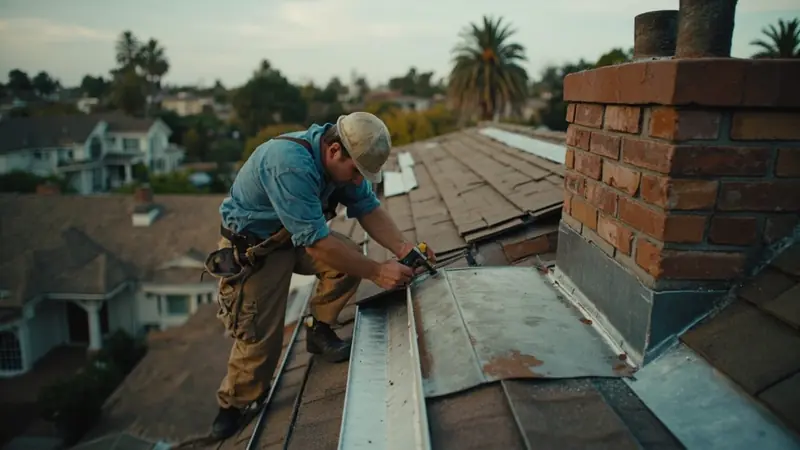
Flashing (the metal that seals joints on the roof) stops water at valleys, walls, chimneys and pipes. When it cracks, lifts or pulls loose, homeowners usually end up calling about cracked or damaged flashing once a stain shows up on the ceiling. The leak often only appears when wind drives rain from one direction, which points at a wall or chimney intersection rather than the open roof field.
Rusted flashing signs, such as streaks down the metal or flaking at the seams, can show up before any water reaches the ceiling inside. You might also find a piece of loose flashing in the yard after a windy night, or see a corner of metal lifted when you look up from the ground.
Flashing pulling away from roof decking at a wall line is often the first thing you notice, even before water shows up inside. Cracked roof flashing at a valley lets rain cross under the shingle courses instead of running down the metal channel below it. Santa Ana gusts in fall and winter drive rain sideways into wall and chimney joints that stay dry in a straight downpour. That is why a leak here often starts after a windy storm rather than a calm one.
What looks like one leak can trace to several different places. It might be a split pipe boot, an open valley, step flashing or counter flashing at a wall or chimney, a missing kickout, or a seam that opened on a flat section over a porch. A leak that only shows up when the wind blows from one side usually points at a wall.
One cause we trace often at a wall intersection is missing kickout flashing, the small piece that should divert roof runoff away from the wall and into the gutter. Without it, water runs behind the siding instead of onto the shingles. The wall sheathing underneath can rot for years with no stain ever showing on the roof itself. That is why a leak at a wall can look minor on the surface and be serious underneath.
Water leaking around flashing at a vent pipe or chimney usually tracks sideways along the underside of the decking before it drops, so the stain rarely sits right under the gap. If the leak isn't tied to one flashing point and keeps showing up in different places after a rain, that points toward a broader roof leak repair rather than one joint. A stain that keeps spreading after each rain, a soft spot in the ceiling drywall, or a mildew smell near a wall means water has been moving behind that wall for a while. That is the point to call, before the next storm adds to it.
If this started as damaged or clogged gutters, that page walks through the causes.

How do you know you need flashing repair or replacement?
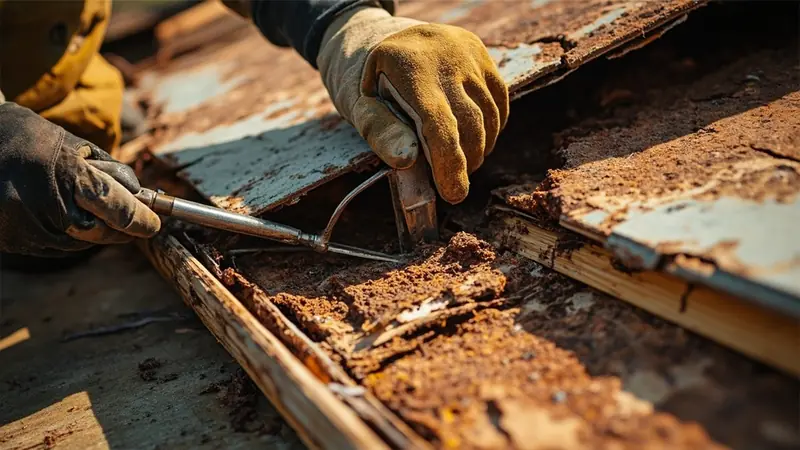
You know you need flashing repair when the finding from the visit points at the metal itself, not just the shingles around it.
- We start in the attic, looking for staining or daylight around the wall and chimney penetrations with a light.
- We check nail tips near those penetrations for rust, which shows where moisture has been sitting.
- We look at the step flashing, counter flashing and valley flashing for cracks, rust-through or caulk that has dried out.
- We check whether kickout flashing is even present where a roof plane ends at a wall.
- We check vent pipe flashing and drip edge for gaps that let water track sideways under the shingles.
- We write up what we found and the repair it points to, in a quote you can look over before anything is opened.
The attic light and nail inspection is the reading that tells us the most. Rust on the nail tips and dark staining around a penetration mean moisture has been condensing there for a while, usually tracing back to a flashing gap rather than a worn-out shingle. Clean nails with no staining, next to a visible crack in the metal, usually mean the fix stays at that one joint.
A damaged roof flashing section at one chimney or wall is usually a flashing repair or replacement at that point. Pulling and resetting counter flashing or valley flashing across a long wall or an entire valley is a bigger job, especially where drip edge and flashing sealant have both failed and let water travel further than the one spot you can see.
Flashing problems that trace back to a missing kickout usually mean adding that piece rather than resealing what's already there. If a section already shows signs of an older repair, such as a second layer of sealant over older flashing, that location often becomes a full reflash instead of another patch. Where the leak is centered on the chimney itself, chimney flashing work usually needs its own closer look at the cricket and the counterflashing around it.
The CSLB License Lookup publishes the rules that govern work like this in your area.
Steps for a flashing repair visit
On site assessment
We start where the leak is easiest to trace, which is usually the attic near the wall or chimney in question. An attic light and nail inspection shows us staining, daylight, and rust on nail tips that point to where water is getting in. From there we go up and check the matching spot on the roof itself, looking at the flashing, the decking around it, and whether a kickout is even in place. You're walked through what we found before we leave, in plain terms. By the time we're done, the cause has a name and you're holding a written quote for the fix.
Repair or replacement
You look over the quote and give the go ahead before anything comes off the wall or roof. If the area is still wet or storm damaged, we secure it first so no more water gets in while the repair is scheduled. The main work follows: pulling the damaged step flashing, counter flashing or valley metal, resetting or replacing it, and adding a kickout where one was missing. Where sheathing underneath turned out to be soft, that gets shown to you and replaced as part of the same opening.
Final check
Before we close everything back up, a pin moisture meter against the decking where the old flashing sat has to read under 15 percent. That tells us the wood under the new metal is dry, not just that the leak looks stopped from the outside. We show you that reading, along with the new flashing, before it's covered by shingles or siding. If the reading comes back higher, we talk through what that means before closing the wall.
What fixing damaged flashing needs in Ontario
This kind of repair usually needs a permit. The City of Ontario Building Department signs off on work like this before it gets covered back up. A straight swap of a damaged section for matching metal in the same spot is usually a smaller review than opening a wall or rebuilding a parapet cap.
A common shortcut here is running a bead of flashing sealant over a cracked piece instead of replacing the metal underneath it. The caulk looks fine for a season, then shrinks and cracks again, and the leak comes back in the same spot. Another shortcut is nailing new counter flashing over the old piece without checking the wall sheathing behind it, which hides rot instead of fixing it. Skipping the kickout flashing when a roof gets reflashed near a wall leaves the same gap that caused the leak in the first place.
What the repair visit involves
Same day or set appointment
We ask two things on the phone: is water actively dripping right now, and is it near a wall or chimney rather than out in the open field of the roof. Active dripping near a wall usually means someone comes out the same day. A leak that already stopped, found after a windy night, usually becomes a set appointment instead. Either way, the location you describe is what we go check first, before anything else.
What the visit disturbs
Reaching flashing at a wall or chimney usually means pulling back a run of shingles or siding right at that joint. Clear anything stored against that section of wall or fence line below it before we arrive. A ladder goes up against that wall, and plants or furniture directly under the work area are worth moving out of the way first.
What decides repair size
A single cracked piece of step flashing at one wall or vent is a smaller job than reflashing an entire valley or wall run. What's underneath the old flashing also matters: dry sheathing keeps the job at the surface, while rot found once the siding or shingles are pulled back opens up more of the wall or deck. Whether drip edge and counter flashing get replaced with the repair or left in place also moves the size up or down. You see the quote in writing and approve it before any of that work starts.
What you see and approve
We show you where the flashing failed, whether that's a photo from the attic or the piece itself once it's pulled out. We walk through the options, such as resealing one joint, replacing a flashing run, or adding a kickout where one is missing. Before any siding, shingle or wall section comes off, we ask for your go ahead. The old flashing comes out where you can see it, so you know what was wrong before it goes in the trailer.
Cracked or Damaged Flashing Questions From Ontario Homeowners
Watch for a roofer who skips the attic and jumps straight to a number without checking anything first. A straight answer shows you the problem, such as rust on nail tips or staining on the sheathing, before naming a fix. Ask to see the old flashing once it's pulled, and ask for the moisture meter reading on the decking before it gets closed up. If someone won't put findings and the repair plan in writing before work starts, or pressures you to decide on the spot, that's a reason to ask more questions.
Flashing replacement size depends on whether one joint failed or a whole valley or wall run needs resetting. Pulling and resetting counter flashing or valley metal across a longer run, especially where drip edge and sealant have both failed, opens up more work. Rot found in the sheathing once the old flashing comes off adds to the job too. You get a written quote that lays out what was found and what the fix involves before anything is opened further.
Flashing repair size in Ontario depends on how much metal needs replacing. Whether the sheathing underneath turned out dry or soft once it's opened also moves the job up or down. Drip edge and counter flashing getting replaced alongside the repair factors in as well. You see a written quote spelling out what was found before any work on the wall or roof continues.
Timing depends on whether water is actively dripping right now and where it's coming from. Active dripping near a wall or chimney usually gets someone out the same day. Either way, the location you describe, whether it's near a wall, a chimney or a valley, is what gets checked first once someone arrives, starting in the attic before moving to the matching spot on the roof.
Checking the attic with a flashlight after a windy rain is the one step a homeowner can safely do. Look for new staining, daylight, or rust at a nail tip near a wall or chimney joint, since that tells you water is getting in at that spot.
Look for a process that starts in the attic before anyone touches the roof. A finding should name the exact point, such as a missing kickout or cracked counter flashing, rather than a vague "roof leak." Ask what they check once the old flashing comes off, including the sheathing underneath it, and whether they'll show you what they found. A written quote that spells out the repair before work starts, in Ontario or anywhere else, is worth asking for up front.
Estimates start with an on-site check. The visit begins in the attic near the wall or chimney in question, using a light and nail inspection to find staining, daylight or rust that points to where water is getting in. From there, the roof gets checked at that same spot for cracked or missing flashing. You get a written quote naming the cause and the repair, and you decide what happens next.
Why wall and parapet flashing fails on older Ontario roofs
Houses built in the 1920s have original board sheathing under mixed flat and pitched roof sections. On a roof like that, a parapet cap or a wall flashing often fails before anything in the open field does. This joint sits where two different roof planes meet and the old sheathing under it was never built with a membrane under the metal. Humid winter air sitting under a flat section over a porch adds to the problem, since board sheathing holds moisture longer than the plywood decking used on newer houses. Summer heat swings move that same metal enough, over time, to open a seam at the wall line. That combination is why we trace leaks on a house from this era to the transitions first, the parapet cap and the wall flashing, rather than walking the field of the roof looking for a worn shingle.
Work on an older roof like this gets looked at before the new flashing is covered, since once shingles or a parapet cap go back down, nobody can see what's underneath them again. On a 1920s structure, that inspection usually focuses on the metal at the wall or parapet joint and on the sheathing it's fastened to, more than on the field of the roof. That's one reason a flashing repair on a house like this gets scheduled in a dry stretch of weather instead of between one storm and the next: the opening has to stay dry long enough for someone to look at it before it's closed back up.
Roofing Services Near Ontario
If you are seeing cracked or damaged flashing anywhere in the Ontario area, call (909) 330-4661 and we can tell you what to check first.
Address:
Ontario Roofing, 4335 E Lowell St, Suite G
More Common Roofing Problems in Ontario
After a windy rain, you can look in the attic with a flashlight for new staining or daylight near a wall or chimney joint. That tells you something is getting in. Stepping onto a wet roof, prying up shingles, or resetting flashing calls for fall protection and belongs to the visit, since a slope that looks dry from the ground can still be dangerous underfoot.
Know when the stain or drip first showed up, and whether it got worse after a particular storm or wind direction. Note which wall or roof section it's near, and the rough age of the roof if you know it. If you can get up to the attic safely, mention whether you saw staining, daylight or rust at a penetration.