
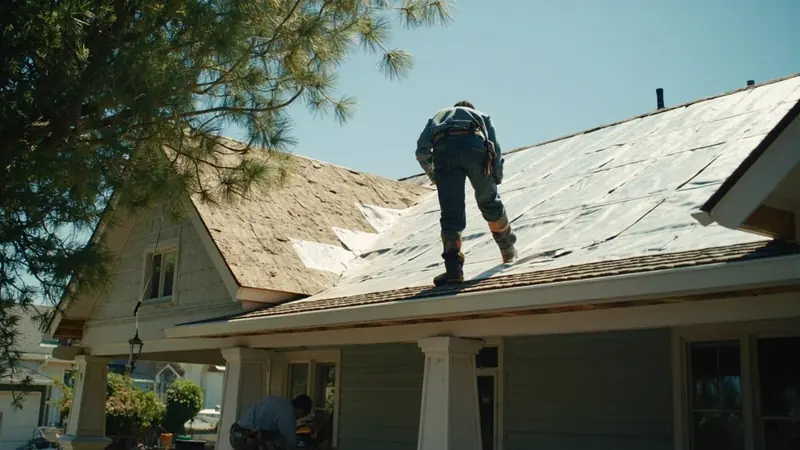
What a roof replacement in Ontario involves
A full roof replacement means the old covering, and the decking underneath it where needed, both come out and get rebuilt, not just a shingle swap on top of what's there.
The lifted tab is where it usually starts. Santa Ana conditions each fall and winter send dry gusts down through the valley, and a tab already pulled loose at the corner gives that wind something to grab. Once that happens, the gust gets under the course sitting above it next. A full strip can tear off in the next windstorm, and the bare decking left behind takes rain directly, with nothing between the wood and the attic below it.
This is exactly when calling makes more sense than waiting, since one loose tab can often settle back into place. A strip missing after a windstorm, or widespread lifted sections, call for a full roof replacement before the next storm hits.
Deciding to replace a roof instead of repairing it again comes down to what sits under the shingles, not just what's on top of them. Ontario's housing stock spans early citrus-era bungalows on raised foundations through 2000s slab-built subdivisions, and older houses often have board sheathing with gaps between the individual boards, while newer construction commonly uses plywood or OSB decking across the whole span.
That difference matters once the old covering comes off, because solid decking has to go down before a modern underlayment installation can be fastened the way a new covering requires. New construction roofing, built against current code on a house going up from the ground, is a separate job from replacing what's already on an existing roof.
Our guide to roof replacement cost guide 2026 covers the choices in plain terms.
Our crews work to the installation standards of the National Roofing Contractors Association.

Find the sign you have, then read across to see how soon to call.
| Symptom or first sign | What is already happening | What it becomes if ignored | When to call |
|---|---|---|---|
| A lifted shingle tab | Wind gets under the course above it | A full strip peels in the next storm and the bare deck takes the rain directly | Call this week |
| Gutters packed with debris | Water backs up behind the drip edge | The fascia and the bottom edge of the decking soften until the first course has nothing | Call this week |
| A cracked pipe boot | Water runs down the vent pipe into the attic insulation | The ceiling below stains and the framing around the penetration softens | Call this week |
| Missing kickout flashing where a roof meets a wall | Water runs behind the siding instead of onto the shingles | The wall sheathing rots with no stain on the roof at all | Call this week |
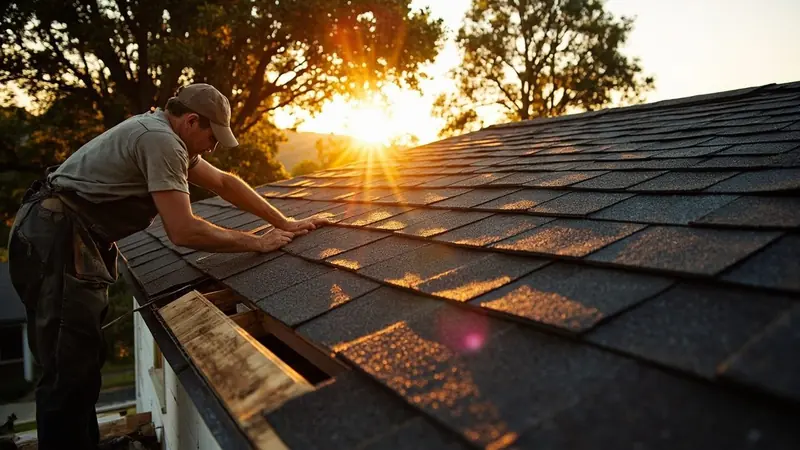
What are the different types of roofing?
Ontario roof replacements mostly choose between three tab shingles, architectural laminated shingles, or standing seam metal for a homeowner planning to stay long term. A low slope membrane only enters the picture where part of the roof is nearly flat, such as over a porch or an attached addition.
The visit that leads to that choice follows a set order.
- We start in the attic, checking for stains, daylight at penetrations, and rusted nail tips.
- We walk the roof itself, including a walk test for deck deflection between rafters.
- We check the shingle tabs for cracking and granule loss where they still flex.
- We confirm soffit intake against ridge exhaust so the new covering doesn't fail the same way.
The walk test decides between a repair and a full replacement. A deck that feels firm underfoot with no give between rafters can usually carry a new covering as is. A deck that feels spongy or springs under your weight between rafters has already delaminated. That section has to come out before any new roof installation goes down, no matter which covering gets chosen.
The wind gusts that move through this valley each fall and winter push the choice toward architectural laminated shingle over three tab. Architectural laminated shingle is two layers glued together, so it's heavier and holds a wind rating commonly stated between 110 and 130 mph, but only when it's nailed to the pattern and starter strip the covering specifies. Three tab is lighter and comes loose sooner in the same gusts.
New construction roofing follows a different path, since it's built against current code before anything else is on the house. A job to replace a roof on an existing structure has to work with whatever decking and venting the original build already has.
Pick the two options that fit your home, then ask which one makes sense for it.
| Option | The numbers a buyer weighs | Best suited to |
|---|---|---|
| Architectural laminated shingle | Two laminated layers that are glued together so it is heavier and thicker than three tab | Most steep slope roofs on a house |
| Impact rated shingle | Graded by a steel ball impact test where Class 4 is the top step | Hail country and exposed roofs |
| Three tab shingle | One layer with cutouts, lighter per square | Low exposure roofs where first cost decides |
How a roof replacement happens
Assessment on site
We start by walking the attic and the roof itself, checking the decking, the shingle tabs, and the soffit to ridge vent balance in the order that finds problems fastest. You come up to see anything we find, whether that's a stain pattern in the attic or a soft spot in the decking under the old covering. Once we know what's holding up and what isn't, we name the cause out loud and write it into a quote you can read through before deciding anything. That quote covers the covering, the decking if it needs replacing, and the flashing work the roof calls for.
Tear-off and rebuild
Once you approve the quote, the old covering comes off down to the decking so nothing gets covered up by mistake. Any board that failed the walk test gets replaced before a single shingle goes back down, and we set it aside so you can see it. From there the underlayment installation, flashing, and ridge cap replacement go down in order, followed by the covering itself. Nothing moves to the next layer until the layer under it is down and checked.
Final check and walkthrough
Before the new covering goes down over any replaced decking, we check it with a pin moisture meter and look for a reading under 15 percent, which reads as dry. Anything higher stays open until it dries or gets swapped, since sealing wet wood under a new roof undoes the rest of the job. We show you that reading on the meter itself, along with the vent count at the soffit and ridge, before the last course closes it up. Then we walk the roof with you once more before packing up, pointing out the flashing points and vent locations so you know where everything sits.
Permits and shortcuts for roof replacement in Ontario
A full tear-off and rebuild typically falls under a permit review by the City of Ontario Building Department, which checks the work against the California Residential Code. A smaller like for like patch on one section is the kind of repair that often skips that step, but replacing the covering and decking across a slope is not treated the same way.
Skipping steps on this job shows up fast in a place that gets both hard sun and hard wind. Reusing old flashing instead of new ridge cap replacement and drip edge installation saves a step on day one, then the old metal lets water track sideways at the next heavy rain because the sealant under it already gave out years ago. Nailing a new covering straight over old decking without checking it first saves another step, then the next windstorm finds the soft spot the old nails were already loose in.
Blocked soffit vents get missed the same way. A new covering goes down over an attic that still can't breathe, and the same moisture problem that aged the old roof starts working on the new one from underneath. Soffit and fascia repair becomes its own job here when the fascia board has already softened from water sitting behind a clogged gutter, since a new drip edge has nothing solid to nail into until that wood is replaced.
Pulling the permit before the tear-off starts means an inspector can look at the exposed decking while it's still open, which is the only point in the job anyone can verify what's underneath the old covering. Houses built decades apart in this city carry different decking underneath, so what gets found on one roof isn't what gets found on the next one two doors down.
For background, see our guide on reading a roofing proposal line by line.
What the job looks like once you call
What decides your visit
On the phone we ask what you're seeing, when it started, and whether water is already inside the house. A ceiling that's wet today, or a strip of shingles missing after a windstorm, usually points to a visit sooner rather than later. A roof that's aging but holding, with no active leak, is easier to schedule around your own week. Either way, we work from what you describe before anyone drives out to look at it.
What the tear-off disturbs
A full roof replacement disturbs the yard and driveway more than the house itself. A dump trailer and material delivery need a clear driveway, so move vehicles out before the visit. Old shingles and nails come off the roof during tear-off and land in the yard below. Plants, furniture, and anything breakable near the eaves should move clear or get covered, since debris falls straight down off the edge where the work is happening that day.
What sets the job size
The biggest unknown is the decking once the old covering comes off, since nobody can see rotted or delaminated boards from the ground. How many old layers have to be removed and hauled away adds to it, along with the pitch and how many stories the roof sits over. A simple gable moves faster than a roof cut up with valleys, dormers, and chimneys. Whether flashing, boots, and ridge cap get replaced with the covering or reused also shifts the job. You see the written quote and approve it before anything is torn off.
What gets shown to you
We show you the problem where it is, whether that's a soft spot on the roof itself or a stain pattern in the attic. You see the options before any decision gets made, including whether the decking needs replacing once the old covering is off. We ask for a go ahead before pulling up anything beyond what the written quote already covers. Any decking we replace gets set aside so you can see exactly what came out from under your roof.
Roof Replacement Questions From Ontario Homeowners
Age alone does not decide it, the walk test on the decking and the condition of the shingle tabs do. A twenty year old roof with tabs that still flex and granules that stay put, sitting over a deck that feels firm with no give between rafters, can often be re-covered. If the tabs crack when lifted or the deck springs underfoot, that roof has moved past a repair. The attic check for staining and daylight at penetrations also factors into which way it goes.
A cracked ridge tile usually means the covering has reached the point where what holds it down is failing. On houses from the 1980s and 1990s, the tile underlayment often gives out before the tile cracks, since the tile itself outlasts what's underneath it. A cracked tile is a sign to check that underlayment and the decking below it, rather than treating the crack as the only problem. The attic gets checked for staining tied to the same spot.
Adding plywood over old board sheathing raises the deck slightly, since you now have two layers where the roof once had one. That small rise changes how flashing sits at the edges and at any transition point, like a wall or chimney, because drip edge and flashing details are made for one deck thickness. On a house with board sheathing and gaps between the boards, solid plywood goes down first so the new underlayment has a continuous surface, and flashing gets fitted to match the new height.
Boards pulled off during tear-off are set aside at the job site so you can see them. Any decking that failed the walk test, felt spongy, or showed staining or daylight at the eaves gets separated out this way before new decking goes down in its place. That lets you look at the actual condition of the wood, whether it delaminated, rotted, or just aged out, rather than taking a description of it secondhand.
Standing seam metal gets chosen where wind resistance matters more than anything else. The Santa Ana gusts that move through this valley each fall and winter are what lift and tear shingle tabs loose first. A metal roof has far fewer loose edges for that wind to grab compared to a shingle tab at a corner. Homeowners planning to stay in the house long term in Ontario often weigh standing seam against architectural laminated shingle for that reason, alongside three tab.
Why board sheathing changes roof replacement in Ontario
College Park, subdivided in 1914 and built out through the 1910s and 1920s, carries roofs over board sheathing laid with gaps between the individual boards rather than a solid plywood deck. Pull the old covering off a roof there and those gaps show up at the eaves as daylight before a nail ever goes back in. That changes the order of work. Solid decking goes down across the whole span first, so the new underlayment has something continuous to seal against, then the covering follows. In Ontario, a roof leak usually shows up first as a ceiling stain or attic moisture, not standing water outside. It shows as a stain working along the rafters inside, which is why the attic gets checked before anyone climbs up. A house from this era also tends toward open eaves, so flashing at the roof edge gets more exposure to wind and sun than a newer subdivision roof sees.
An inspector looks at the exposed decking once the old covering is off, before anything new gets nailed down, which is the only point anyone can confirm what shape the wood is in. That matters across every era of Ontario roof. Postwar ranch houses built through the 1970s carry roofs that are simply worn out from decades of summer heat and winter rain, while houses from the 1980s and 1990s usually fail at the tile underlayment long before the tile itself cracks, since the tile outlasts what's holding it down. Either way, the inspection point is what sets whether the decking under that covering gets rebuilt or just covered again.
Roof Replacement Across Ontario and Nearby Towns
Our Ontario crew also covers these towns for roof replacement.
Roofing Services Near Ontario
Need roof replacement in Ontario? We cover the city and the nearby towns on the map. Call (909) 330-4661 to check your address.
Address:
Ontario Roofing, 4335 E Lowell St, Suite G
More Residential Roofing Services in Ontario
After a windstorm, you can look through the attic with a flashlight for new staining or daylight at the roof deck. That tells you something changed, but walking the slope to find exactly where is not something to do from inside the house. Checking tabs, flashing, and decking from on top of the roof belongs to the visit, since that work needs fall protection most homeowners don't have on hand.
Before you call, know when the symptom started and what changed right before it, such as a windstorm or a heavy rain. If you know roughly how old the current roof is, have that ready too. Check whether you can see daylight or staining from inside the attic, and note which slope of the roof it's on if you can tell from the ground.